
Photo by the Washington Climate Partnership Team
Soil Health as a Cornerstone of Washington’s Climate Strategy
Washington’s Comprehensive Climate Action Plan recognizes that healthier soils are not only critical carbon sinks, but also key to sustaining food systems, improving water quality, reducing climate vulnerabilities, and strengthening rural economies.
Author: Corinn Rutkoski
June 15, 2026
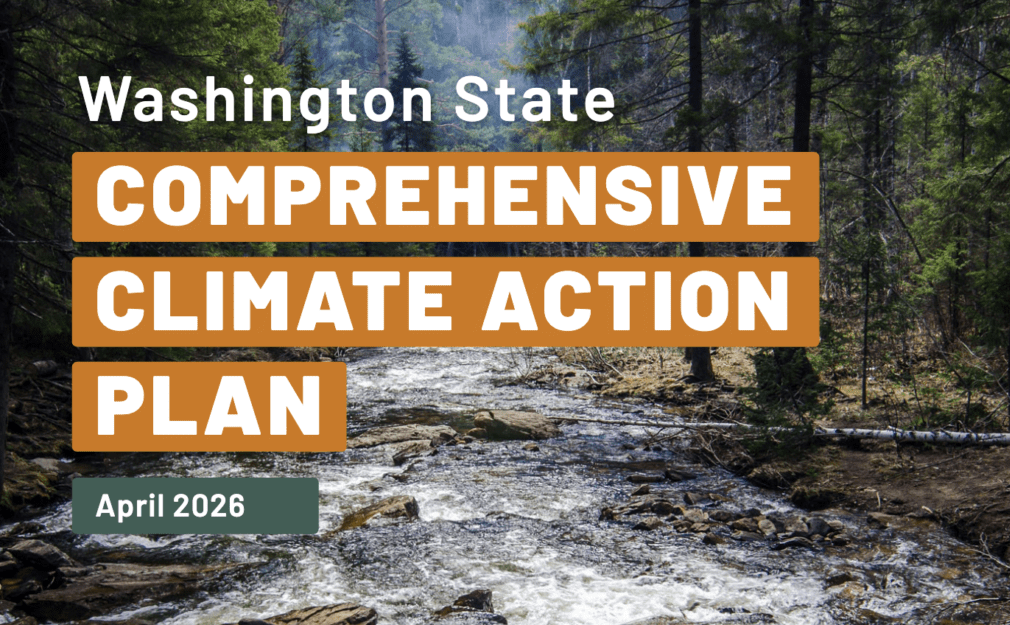
Washington’s Comprehensive Climate Action Plan (CCAP), released in April 2026, provides a statewide roadmap for meeting legally mandated greenhouse gas reduction targets for 2030, 2040, and 2050 while delivering tangible benefits to communities across the state. Developed through extensive collaboration among state agencies, Tribes, local governments, stakeholders, and the public, the CCAP outlines 36 strategies and more than 130 measures spanning every sector of the economy.
Within this framework, soil health emerges as a foundational climate solution, particularly in the agriculture and natural and working lands sectors. The CCAP recognizes that healthier soils are not only critical carbon sinks, but also key to sustaining food systems, improving water quality, reducing climate vulnerabilities, and strengthening rural economies statewide.

Agriculture Sector Focus: Improving Soil Health
Within the Agriculture sector, Strategy E.1: Improve Soil Health is a priority climate action. The CCAP emphasizes expanding climate-smart practices that build soil organic carbon, reduce nutrient losses, and improve long-term productivity. Key practices include reduced and no-till farming, cover cropping, perennial crop systems, rotational grazing, and the application of organic soil amendments such as compost and biochar.
The Washington Soil Health Initiative (WaSHI) is identified as a central institutional pillar supporting this work. The CCAP acknowledges the role that WaSHI programs - like Sustainable Farms and Fields (SFF) and Saving Tomorrow’s Agriculture Resources (STAR) – can play in providing financial incentives and technical assistance for producers adopting soil-carbon-building practices. WaSHI programs support thousands of acres annually and form the backbone of Washington’s soil health climate strategy.
Fertilizer and Irrigation Efficiency to Reduce Nitrous Oxide
Nitrous oxide from fertilizer application accounts for roughly one-third of agricultural emissions in Washington, making nutrient efficiency a critical soil health priority. Under Measure E.1.2, the CCAP calls for expanding tools and incentives that help farmers optimize fertilization and irrigation. This includes nutrient management planning, enhanced-efficiency fertilizers, nitrification inhibitors, irrigation scheduling technology, and improved data collection.
A WSU–WSDA nutrient and irrigation management system, AgWeatherNet, is identified as a key enabling tool. By aligning soil, crop, and climate data, the system aims to reduce excess nitrogen loss while improving yields, cutting both emissions and costs for producers.

Carbon-Sequestering Soil Amendments
One of the CCAP’s highest-priority agriculture actions is Measure E.1.4: Establish a carbon-sequestering soil amendment subsidy program. This measure builds on successful compost reimbursement efforts that previously offered 50 percent cost-share for compost application. Between 2024 and 2025, these programs sequestered more than 15,000 metric tons of carbon, demonstrating immediate climate benefits alongside soil health gains.
The CCAP recommends restoring and scaling these subsidies and expanding them to include biochar, enhanced rock weathering (such as basalt dust), and other innovative amendments. These materials offer long-term carbon storage and improve soil structure, water holding capacity, and nutrient cycling. Importantly, the plan notes that these tools can be adapted for farms of all sizes, including small, urban, and Tribal agricultural operations.
Expanding Agroforestry for Soil and Climate Benefits
Agroforestry (Strategy E.2) plays a complementary role in Washington’s soil health framework by integrating trees and shrubs into working agricultural landscapes. Practices such as riparian buffers, shelterbelts, silvopasture, alley cropping, and forest farming improve soil stability, increase carbon storage, reduce erosion, and enhance water quality.
The CCAP identifies Measure E.2.1: Increase funding and technical assistance to accelerate adoption of agroforestry as a priority action. By embedding perennial vegetation into farms, agroforestry systems also support biodiversity, microclimate regulation, and farm resilience to drought and heat while maintaining productivity. Modeled greenhouse gas reductions from agroforestry are expected to grow steadily through 2050 as adoption increases.
Local Food Systems and Transformational Agriculture
Under Strategy E.5: Transform Agricultural Systems, the CCAP highlights investments in local food systems as an indirect yet powerful soil health strategy. Shorter supply chains, diversified cropping, and regional processing infrastructure support regenerative practices that build soil organic matter while reducing transportation emissions and food waste.
Programs such as Farm to School, Farm to Food Pantry, and SNAP Market Match are explicitly linked to improved soil outcomes by encouraging diversified rotations, perennial crops, and reduced reliance on synthetic inputs. These investments reinforce soil health while advancing food security and equity goals.

Natural and Working Lands: Protecting and Building Soil Carbon
Beyond farms, the CCAP places soil health at the center of the Natural and Working Lands sector (Strategy F). Strategies F.1 and F.2 prioritize protecting carbon-dense ecosystems such as forests, grasslands, wetlands, floodplains, and peatlands, and enhancing their capacity to sequester and store carbon in soils. Avoiding land conversion is identified as one of the most powerful near-term soil carbon strategies for Washington state.
Priority measures include restoring riparian corridors, reconnecting floodplains, applying wildfire resilience treatments, and planting climate-adapted vegetation. Together, these actions protect existing soil carbon stocks while increasing long-term sequestration potential, especially in rural and forested regions.
Monitoring, Equity, and Implementation
To ensure credibility and effectiveness, the CCAP calls for improved monitoring, reporting, and verification of soil carbon and land-based carbon dioxide removal. Clear definitions of “net zero” and standardized accounting frameworks are needed to track soil health changes over time.
Equity is woven throughout these strategies. Soil health investments are explicitly designed to benefit overburdened, rural, and Tribal communities. Expanded technical assistance, flexible funding, and regionally tailored approaches are emphasized to ensure broad participation and meaningful community benefits.
Looking Ahead
The CCAP positions soil health not as a niche agricultural concern, but as a foundational climate solution that bridges emissions reduction, resilience, and economic growth. WaSHI will continue to be a key player in helping Washington achieve these soil health-based climate goals. By scaling proven practices, restoring funding for soil amendments, expanding agroforestry, and protecting carbon-rich landscapes, the CCAP provides a plan to address climate needs while strengthening the natural systems that sustain communities across the state.

Corinn Rutkoski
Corinn Rutkoski is an Extension Coordinator for the Washington Soil Health Initiative at Washington State University.
This article was published by the Washington Soil Health Initiative. For more information, visit wasoilhealth.org. To have these posts delivered straight to your inbox, subscribe to the WaSHI newsletter. To find a soil science technical service provider, visit the Washington State University Extension website or the Washington State Conservation District website.