
Photo by WSU
Putting Peaola to the Test
Lauren Stubbs, a PhD student in soil science, received the 2026 Lawrence Hickman Fellowship to study pea-canola intercropping as an alternative cropping system for eastern Washington.
Author: WSU Center for Sustaining Agriculture and Natural Resources
August 4, 2026
This article was originally published by the Washington State University Center for Sustaining Agriculture and Natural Resources. Read the original article here.
Lauren Stubbs is both a fifth-generation Whitman County farmer and a graduate researcher at WSU. Her family began using no-till farming nearly 30 years ago to reduce erosion, build soil health, and protect the long-term viability of their dryland wheat farm.
That experience shaped Lauren’s interest in soil health and alternative dryland cropping systems. After earning her bachelor’s degree in integrated plant sciences from WSU in 2024, she began pursuing a PhD in soil science.
Her four-year dissertation project investigates pea-canola intercropping, often called “peaola,” in eastern Washington’s intermediate-rainfall zone. The practice involves growing peas and canola in the same field at the same time.
Both crops are commonly grown in rotation with winter wheat, and each offers different agronomic benefits. Peas can obtain nitrogen through relationships with nitrogen-fixing bacteria, while canola’s deep taproots help it access water and nutrients deeper in the soil. Growing the crops together could reduce fertilizer needs, improve land-use efficiency, limit erosion, and provide greater resilience under dry or variable growing conditions.
However, peaola has not been widely tested at a commercial scale in eastern Washington. Producers interested in the practice face uncertainties related to seeding, weed management, harvesting, grain separation, crop insurance, and profitability.
“Without accurate measures of the benefits derived from intercropping, it is difficult to justify implementing the practice on a field scale,” Lauren said.
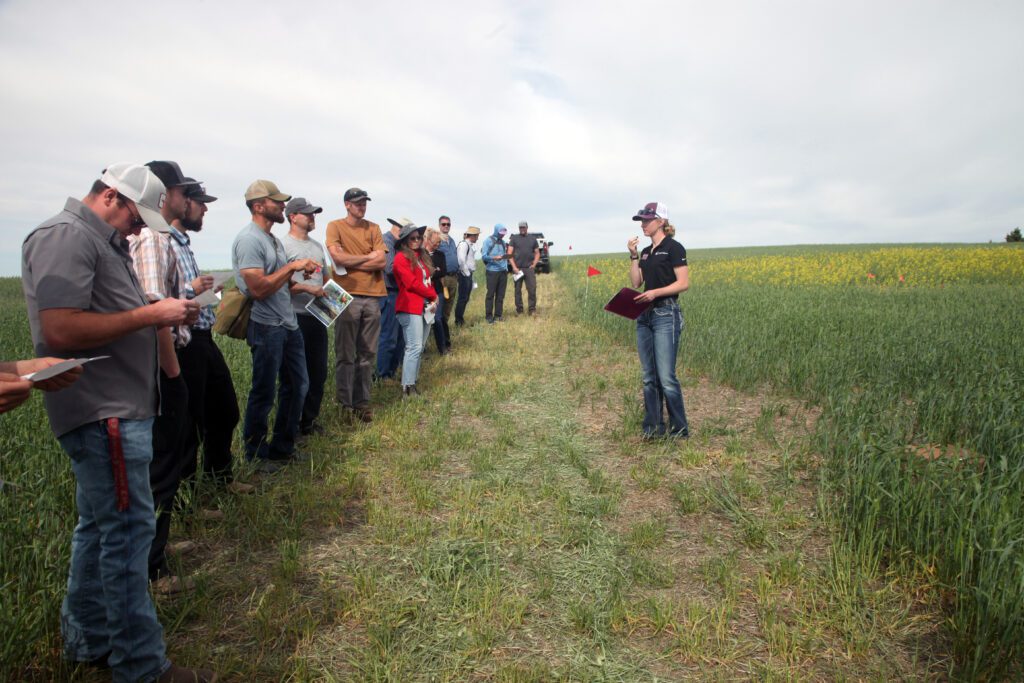
Working with faculty advisor Dr. Shikha Singh, Lauren manages small-plot trials at WSU’s Wilke Research and Extension Farm in Davenport. The trials compare different pea-to-canola seeding ratios and nitrogen fertilizer regimes.

Lauren plans to use the results to develop a cost-savings matrix that producers can adjust based on seed, fertilizer, grain separation, and commodity prices. She also hopes to create a Pacific Northwest Extension publication with practical guidance on growing and harvesting peaola and eventually expand the research through on-farm trials.
The Lawrence Hickman Fellowship will support Lauren’s research and efforts to make the findings useful to growers. After completing her PhD in 2028, she plans to continue working on her family farm while serving as a research associate at the WSU Lind Dryland Research Station.
“This project is special to me for many reasons, the foremost being that we grow canola and peas as rotation crops on my family’s western Whitman County, WA dryland wheat farm, and I have a great appreciation for the agronomic benefits derived from growing these crops,” Lauren said. “It is imperative that we continue developing solutions that will improve the livelihoods of eastern Washington producers and protect our region’s most valuable natural resources.”
About the Fellowship
The Lawrence Hickman Endowed Graduate Fellowship in Sustainable Agriculture supports WSU graduate students researching sustainable dryland farming systems. Ellen Hickman Williams established the fellowship in 2019 in honor of her father, Lawrence Earl Hickman, whose family farm is in Whitman County.

This article was published by the Washington Soil Health Initiative. For more information, visit wasoilhealth.org. To have these posts delivered straight to your inbox, subscribe to the WaSHI newsletter. To find a soil science technical service provider, visit the Washington State University Extension website or the Washington State Conservation District website.