
Focus on Farming & Forestry Conference
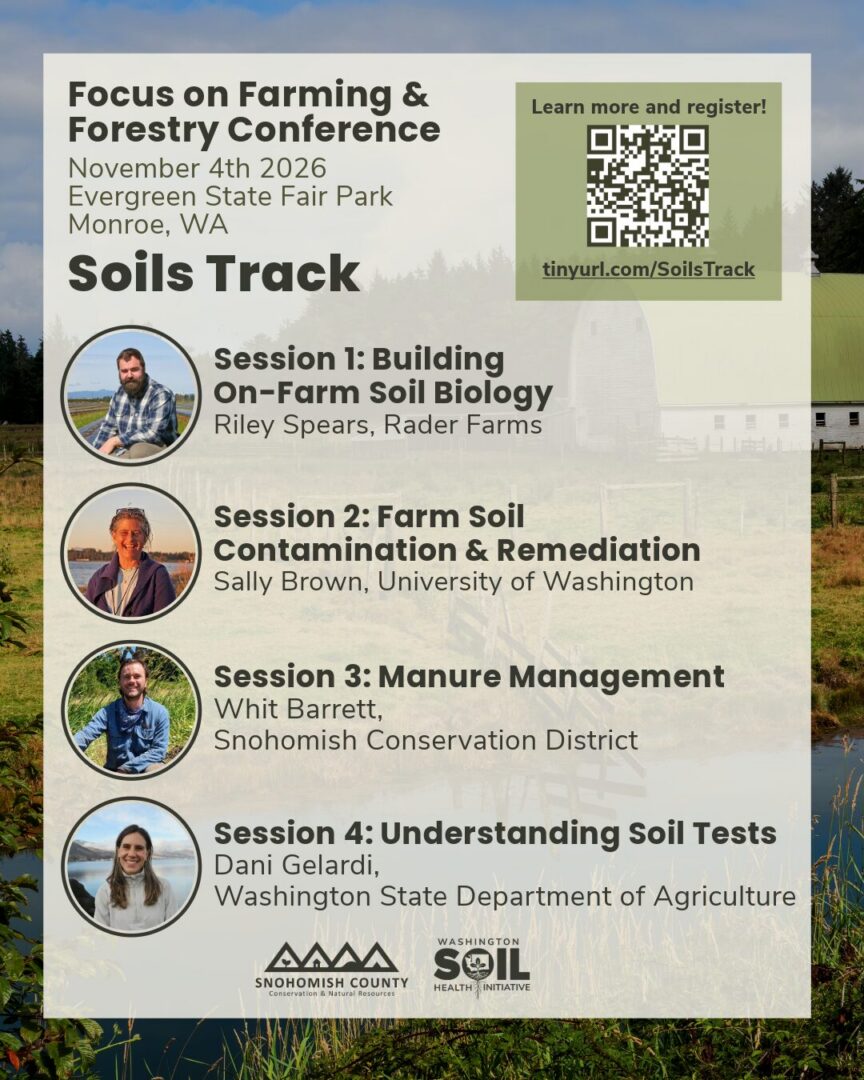
Hosted by Snohomish County, the annual Focus on Farming & Forestry Conference unites large and small, organic and conventional farmers, livestock raisers, and woodland stewards. It features educational workshops, industry keynote presentations, and an indoor trade show highlighting modern agricultural equipment, local non-profits, and research.
The Washington Soil Health Initiative is hosting the Soils track for this year’s conference, featuring the following sessions:
Session 1: Building On-Farm Soil Biology • Riley Spears, Production Manager Rader Farms
Riley Spears manages production at Rader Farms, a large raspberry operation in Lynden, WA focused on balancing productivity with long-term soil stewardship. With approximately 1,000 acres in production, including nearly 600 acres of raspberries, Riley oversees a constantly rotating system of planting, harvesting, and field renewal. In this session, Riley will describe efforts he has led to build on-farm soil health, including soil fungi inoculation, worm compost tea, and runway cover crops.
Session 2: Farm Soil Contamination and Remediation • Sally Brown, Professor of Environmental & Forest Sciences, University of Washington
Sally Brown is a Professor of Environmental and Forest Sciences at the University of Washington, where her research focuses on reclaiming waste materials to promote soil health, climate change mitigation, and biosolids recycling. This session will explore practical strategies for assessing and managing soil contamination in agricultural systems. Detection of contaminants including metals and organics generally does not mean that these pose any real-world risk. Understanding what to test for and how to interpret testing results will be a focus. Risk pathways, soil analysis, and understanding when to be concerned will also be a focus. Benefits of amendments including composts and biosolids, as well as tools for communication, will also be presented.
Session 3: Manure Management • Whit Barrett, Agriculture & Agroforestry Planner, Snohomish Conservation District
Whit Barrett is an Agriculture and Agroforestry Planner for the Snohomish Conservation District’s Agriculture Team, where they provide technical assistance, farm/agroforestry planning, and outreach to agricultural and small forest operators. In this session, Whit will review best practices for manure storage, handling, composting, and field application. When managed effectively, manure can be a valuable asset for improving soil health, reducing input costs, and improving pasture and cropland productivity. Special considerations for manure management on smaller properties will also be discussed.
Session 4: Understanding Soil Tests • Dani Gelardi, Director of Conservation Policy & Research, Washington State Department of Agriculture
Dani Gelardi (she/her) is the Director of Conservation Policy & Research for the Washington Department of Agriculture. She leads soil and climate efforts for the agency including the Washington Soil Health Initiative. In this session, Dani will provide an overview of soil health testing, explaining how to collect soil samples and how to interpret soil test results within the context of local soils, management practices, and long-term trends. Attendees will learn the importance of foundational indicators such as soil texture, pH, cation exchange capacity, and soil organic matter, while also introducing newer biological, chemical, and physical soil health metrics.
Learn more and register here!