
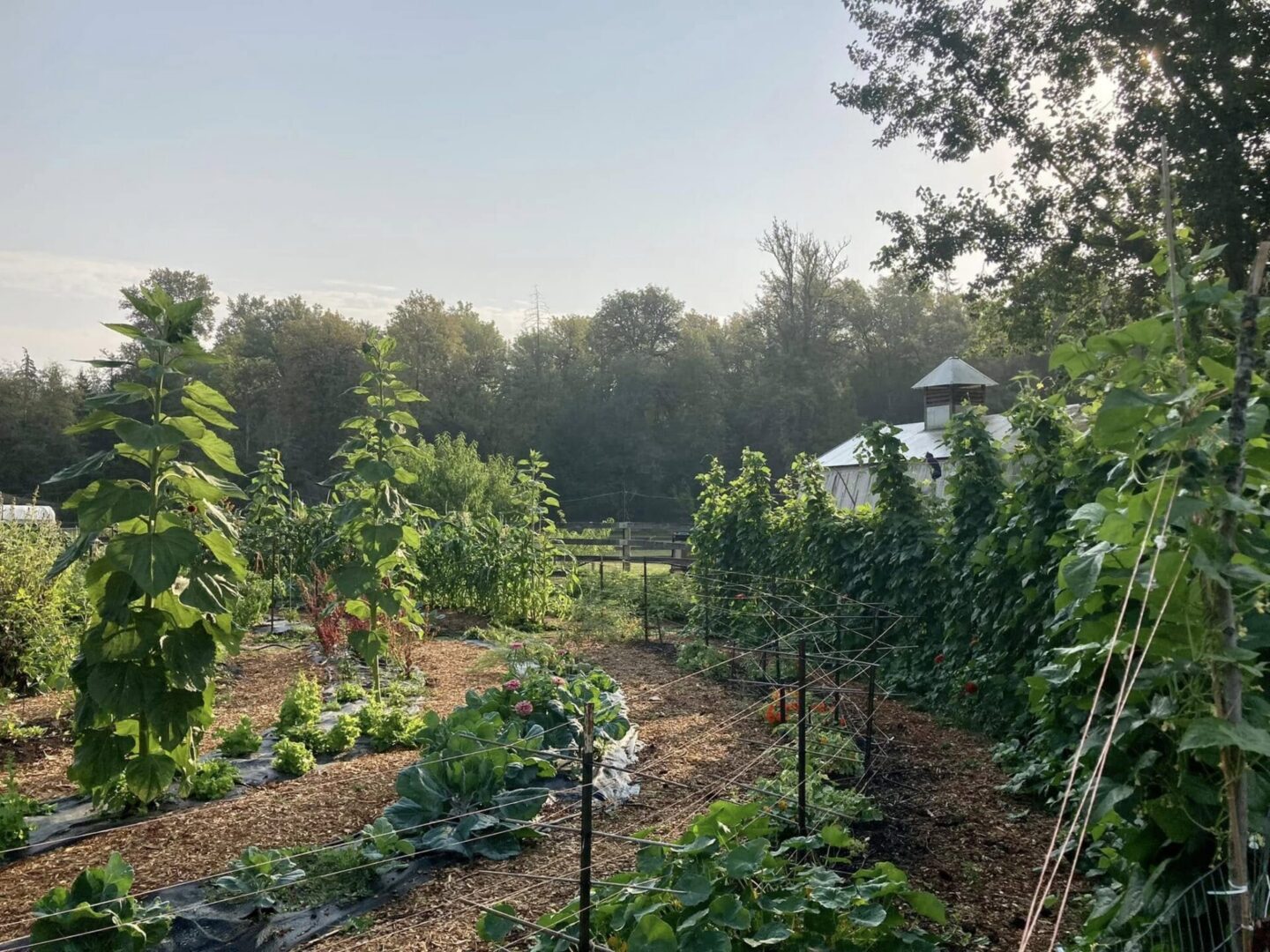
Photo: Salish Roots Farm
Indigenous Agroforestry at Salish Roots Farm: Conservation Grounded in Relationships
At Salish Roots Farm on Squaxin Island Tribe land, a project supported by the Sustainable Farms and Fields program has transformed a riparian area into a productive, harvestable landscape rooted in culture, ecology, and community.
Author: Corinn Rutkoski
September 15, 2026
At Salish Roots Farm on Squaxin Island Tribe land, a project supported by the Sustainable Farms and Fields program has transformed a riparian area into a productive, harvestable landscape rooted in culture, ecology, and community. This initiative demonstrates how Indigenous-led land stewardship, supported through flexible funding and strong partnerships, can meet conservation standards while restoring access to traditional plant foods, medicine, and fiber.
Implemented through a close collaboration between Squaxin Island Tribe and Mason Conservation District (MCD), the project embodies a conservation paradigm that recognizes people as part of the ecosystem rather than separate from it.

Origins and Relationship-Building
Salish Roots Farm was established in 2016 as a community garden and food sovereignty program of the Squaxin Island Tribe. Early conservation work at the farm focused on small pollinator plantings and riparian restoration. A few years into the farm’s establishment, Community Garden Program Manager Patricia Green began working with MCD to explore how farm conservation efforts also restore safe access to traditional gathering sites.
These early discussions were less about specific practices and more about rebuilding trust. Many tribal members had experienced conservation approaches that restricted access to culturally significant plants. Over time, and through consistent relationship-building, both partners developed a shared vision for a project that could meet ecological goals while supporting Indigenous harvesting and teaching.
Rethinking the Riparian Buffer: A Working Landscape
Central to the project was the idea of a “working riparian buffer.” Traditional riparian buffer regulations often emphasize no-touch zones, which can limit both agricultural use and cultural gathering.
The Tribe negotiated a 150-foot buffer to protect water quality and stream function. The Indigenous Agroforestry Project then added an additional 50 feet, creating a 200-foot total buffer that remained compliant with conservation standards while allowing gathering and teaching. This extension became the heart of the agroforestry system: a mosaic of edible, medicinal, and fiber plants organized into harvestable zones.
Working buffers like this offer a much-needed middle ground. They demonstrate that conservation goals - such as soil health, pollinator habitat, and temperature regulation - can be achieved without removing land entirely from productive or cultural use.
“This project was approached through the lens of conservation planning to lessen the burden of maintenance and demonstrate that the working buffer option can be a way to go. There are still benefits for the system and for producers, and it can be accessed as an active space.”
– Margaret Kreder
Designing for Ecology, Culture, and Education
Planting design was led by a collaborative team from MCD, including Agricultural Program Manager Nick Schneider, Stewardship Forester Margaret Kreder, and Sabina Ahmed - who joined as an Evergreen State College intern and is now MCD’s Agroforester and Conservation Planner. The team worked with Patricia to organize planting zones based on both ecological conditions and cultural uses.
Certain zones focused on basketry plants, others on traditional foods like blueberries and medicinal shrubs such as dogwood. A windbreak shelterbelt was designed to reduce noise from logging trucks while functioning as habitat and carbon storage. Throughout the site, interpretive signs were installed to explain each zone’s purpose, key species, and associated NRCS conservation practices, bridging Western conservation science and Indigenous knowledge systems.
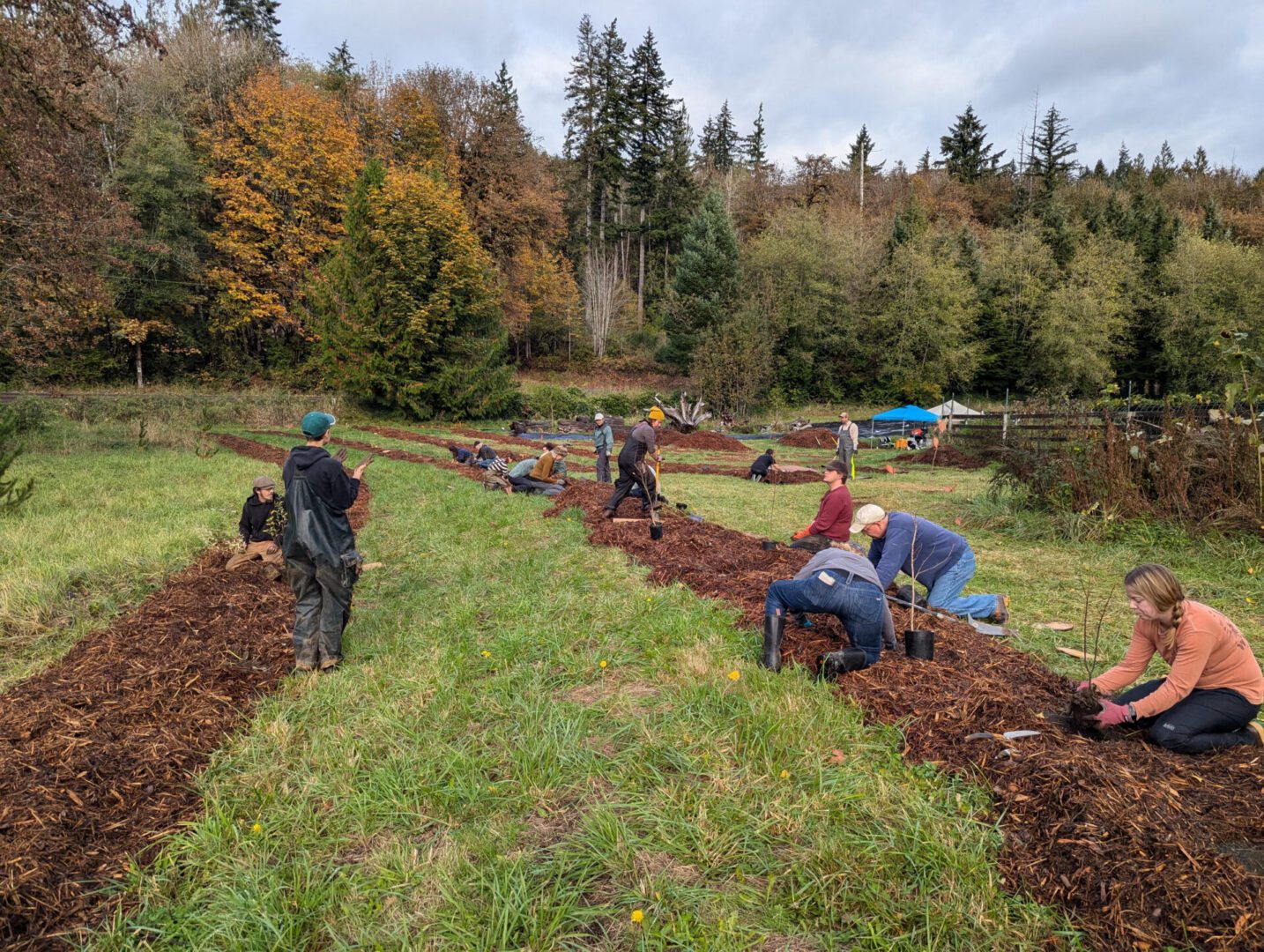
Implementing the planting required intense on-the-ground labor. Sabina coordinated much of this work, helping translate between Western conservation frameworks and Indigenous agroforestry perspectives. She drew from her background in basketry and her work with Patricia to study Indigenous forest gardens - managed landscapes that prioritize human-plant relationships.
Community Engagement Through Work and Celebration
Workshops and volunteer days played a dual role, advancing the project while welcoming new people into the process. Events like Orca Recovery Day linked upland plantings to broader ecological systems, including Chinook salmon and Southern Resident orcas. Workdays created new points of connection to land stewardship by welcoming a broad array of volunteers, including people new to outdoor work.
The project culminated in the first Indigenous Agroforestry Festival in 2025, featuring plant demonstrations, a bigleaf maple syrup showcase, scavenger hunts along the buffer, and educational booths hosted by partners such as Washington State University and the Indigenous Agroforestry Network. Several Squaxin Council members attended, and new connections emerged, including a cedar log donation for tribal carving. A second annual festival took place in June 2026, celebrating the garden’s 10-year anniversary and coinciding with the Indigenous Agroforestry Network’s annual gathering.
The Indigenous Agroforestry Festival invited the community to connect with local artists, restaurants and vendors and see examples of agroforestry practices.
Teaching, Healing, and Living Curriculum
The project supports therapeutic and educational programs such as the plant-teaching social-emotional curriculum developed in collaboration with GRuB and Northwest Indian Treatment Center. Each plant is paired with social-emotional skills and cultural teachings, allowing participants to learn coping strategies through land-based practice.
“Our plan is to use this plant teaching curriculum to teach the community how to gather again and how to build skills to cope with whatever life throws at them.”
- Patricia Green
The agroforestry planting now includes all the plants featured in this curriculum, many of which were previously unavailable on the property. Additional resources, such as the 13 Moons curriculum from the Swinomish Tribe, further support this holistic approach to healing and education.
Interpretive signs were installed to explain each zone’s purpose, key species, and associated NRCS
conservation practices, bridging Western conservation science and Indigenous knowledge systems.
Funding Flexibility and Structural Barriers
This complex, multi-practice project was made possible through the Washington State Conservation Commission’s Sustainable Farms and Fields (SFF) funding, which provided flexibility not available in many conservation programs. MCD emphasized that the funding allowed the creation of demonstration areas showcasing diverse practices rather than forcing a single narrow outcome.
However, challenges remain. State budget cuts threaten future funding availability, and historical barriers - including project requirements centered on Western conservation science principles and cost-share structures that offered tribes lower reimbursement rates than non-tribal applicants - must continue to be addressed across agencies. While some agencies have allowed exemptions and adjusted application timelines to improve tribes’ funding access, long-term equity will require continued policy changes.
A Replicable Model Grounded in Indigenous Leadership
The impact of the Salish Roots Farm project is already spreading. The Washington State Department of Natural Resources ecologists have visited the site and plan to replicate the approach at Kennedy Creek natural preserve areas, centered explicitly on Squaxin Island voices and leadership. Upcoming conferences will further showcase the project to tribes and agencies across the region.
The project team was clear: Indigenous agroforestry must be Indigenous-led. While non-tribal partners bring valuable skills and resources, a meaningful project needs tribal leadership. Patricia’s openness, strategic vision, and role as a trusted point person made this collaboration possible.
Together, the Squaxin Island Tribe and Mason Conservation District have demonstrated that conservation does not have to mean exclusion. When trust, flexibility, and Indigenous leadership guide the work, landscapes can become places of productivity, learning, and renewal for people and ecosystems alike.
“Western conservation science has this idea that the “ideal” state of the land is void of human activity. That really goes against Indigenous practices, where the people are a part of the land. This project was a way to show that people, culture, and land management can all exist together.”
- Sabina Ahmed

Corinn Rutkoski
Corinn Rutkoski is an Extension Coordinator for the Washington Soil Health Initiative at Washington State University.
This article was published by the Washington Soil Health Initiative. For more information, visit wasoilhealth.org. To have these posts delivered straight to your inbox, subscribe to the WaSHI newsletter. To find a soil science technical service provider, visit the Washington State University Extension website or the Washington State Conservation District website.