

© Corinn Rutkoski
Orchards and outlooks: a recap of the 2025 WaSHI Soil Health Tour
WaSHI collaborators convened for a trio of events to learn about tree fruit soil health and set priorities for advancing soil health in Washington.
Author: Corinn Rutkoski
October 27, 2025
Earlier this month, the Washington Soil Health Initiative (WaSHI) team convened for a 3-day event in Central Washington to tour experimental and commercial orchards in the region and to set priorities for WaSHI research and outreach. A broad group of WaSHI collaborators, including legislators, growers, and the WaSHI Advisory Team, were able to see firsthand examples of soil health-building practices in tree fruit production.
Setting the course for long-term research
The event kicked off with a meeting among leaders of WaSHI’s Long-Term Agroecological Research and Extension (LTARE) sites. Researchers shared updates, successes, and challenges at their respective sites, and the group strategized shared goals around data management, resource sharing, and outreach.

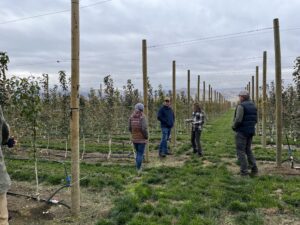
At KMO Orchard, Derek Tomasini shares how organic matter additions and compost production play a role in their apple, pear, and cherry production.
Soil health innovation in action
Next, the team set out for a full-day tour of Central Washington’s tree fruit production systems. Participants visited several sites that exemplify soil health innovation. At KMO Orchard, Derek Tomasini demonstrated how composting and long-term organic matter additions are transforming apple and cherry production. The group then traveled to the WSU Tree Fruit Research and Extension Center Sunrise Orchard, where site lead Tianna DuPont (WSU) shared research from the WaSHI Tree Fruit LTARE site, emphasizing the importance of long-term agroecological data.
Lunch featured updates from Karen Hills (WSCC), along with Ryan Williams and Elizabeth Jackson (Cascadia Conservation District), who discussed the Sustainable Farms and Fields Program and its role in supporting growers with soil health-building practices.
The afternoon included a visit to Columbia Fruit Orchard, where Jeff Cleveringa highlighted the use of mulch, compost, and biochar to improve soil structure and carbon sequestration. Our final stop was Royal Family Farm, where Austin Allred and Michael Hebdon showcased regenerative farming techniques including compost production, vermicomposting, and biochar production.

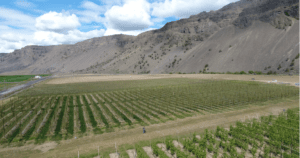
Apples are ripe for harvest at the Central WA Tree Fruit LTARE site. The orchard is a long-term experiment that tests different organic matter additions including mulch, compost, and mowed grass clippings.
Read more about the Central Washington Tree Fruit LTARE site
Growing forward
On the final day of the event, WaSHI’s Advisory Team convened to hear updates on WaSHI programs progress and help set priorities for future work. The WaSHI Advisory Team is a group of producers and representatives from NGOs, Conservation Districts, and state agencies. The meeting opened with introductions and updates across agencies and ended with a brainstorm session to set short-term and long-term WaSHI goals. The passion and expertise of the Advisory Team is invaluable – the group ensures that WaSHI’s work remains relevant and impactful for agricultural production across the state.
Together, this trio of events reflect WaSHI’s holistic approach to soil health – combining rigorous research, field-based learning, and relationship-building across sectors. As WaSHI continues to grow, the ideas generated here will shape the future of soil health in Washington.

Tree fruit soils are amended with biochar at Columbia Fruit Orchard, managed by Jeff Cleveringa.

Corinn Rutkoski
Corinn is an Extension Coordinator with Washington State University, where she facilitates communications, research, and outreach for the Washington Soil Health Initiative.
This article was published by the Washington Soil Health Initiative. For more information, visit wasoilhealth.org. To have these posts delivered straight to your inbox, subscribe to the WaSHI newsletter. To find a soil science technical service provider, visit the Washington State University Extension website or the Washington State Conservation District website.