

© Leslie Michel, WSDA
Soil Health Ambassador: Doug Schuster – Applying compost in dryland wheat
Learn from Doug Schuster about applying compost to erosion-prone hilltops in Washington’s dryland wheat fallow region.
Author: Leslie Michel, Washington State Department of Agriculture, Quotes from Doug Schuster
September 3, 2025
Introducing Doug Schuster
On rolling farmland near Saint John, Doug Schuster farms with his daughter Erin, carrying forward a four-generation farming legacy. The Schuster family began farming just east of the Rock Lake area in 1938. Doug’s father grew up there but moved away from the farm, and in 1979 Doug came to work with his uncle and never left. Together Doug and his daughter manage a diverse operation that includes spring wheat, barley, canola, over 100 acres of alfalfa hay, grass hay, and a cow herd that makes use of their channeled scabland.
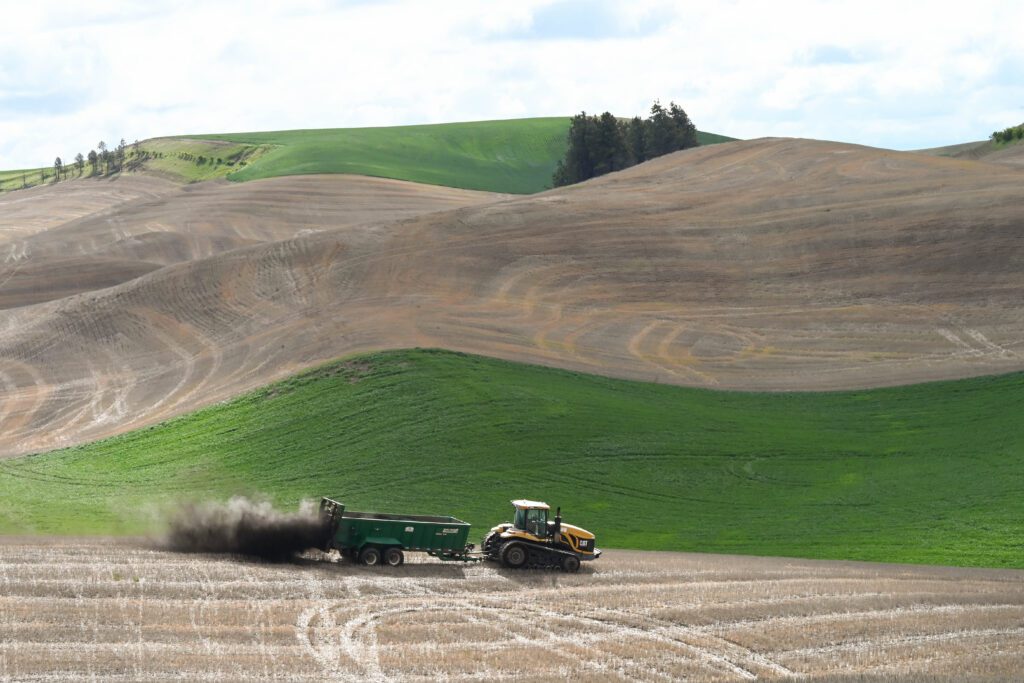
Generations of intensive tillage across the Palouse has slowly eroded the hilltops, reducing topsoil and ultimately farm yield. For over a decade, Doug has been experimenting with ways to improve hilltop soil for increased production, most recently using compost to improve biology and water holding capacity in the thin topsoil.
Watch the video with audio descriptions here.
He believes improving soil health is central to keeping the farm resilient and productive for future generations.
“At the end of the day, yield is what keeps you in business. If you can improve your soil and get better yields through tough times, you’ll have a better chance of staying on the farm. But it’s not just about the money. When you’re all done farming, you want to know that you improved your piece of dirt rather than degrading it.”
To learn more about Doug Schuster and the application of compost to erosion-prone hilltops, watch our interview or read the (minimally edited) transcript below.
Why was it important to you to start applying compost?
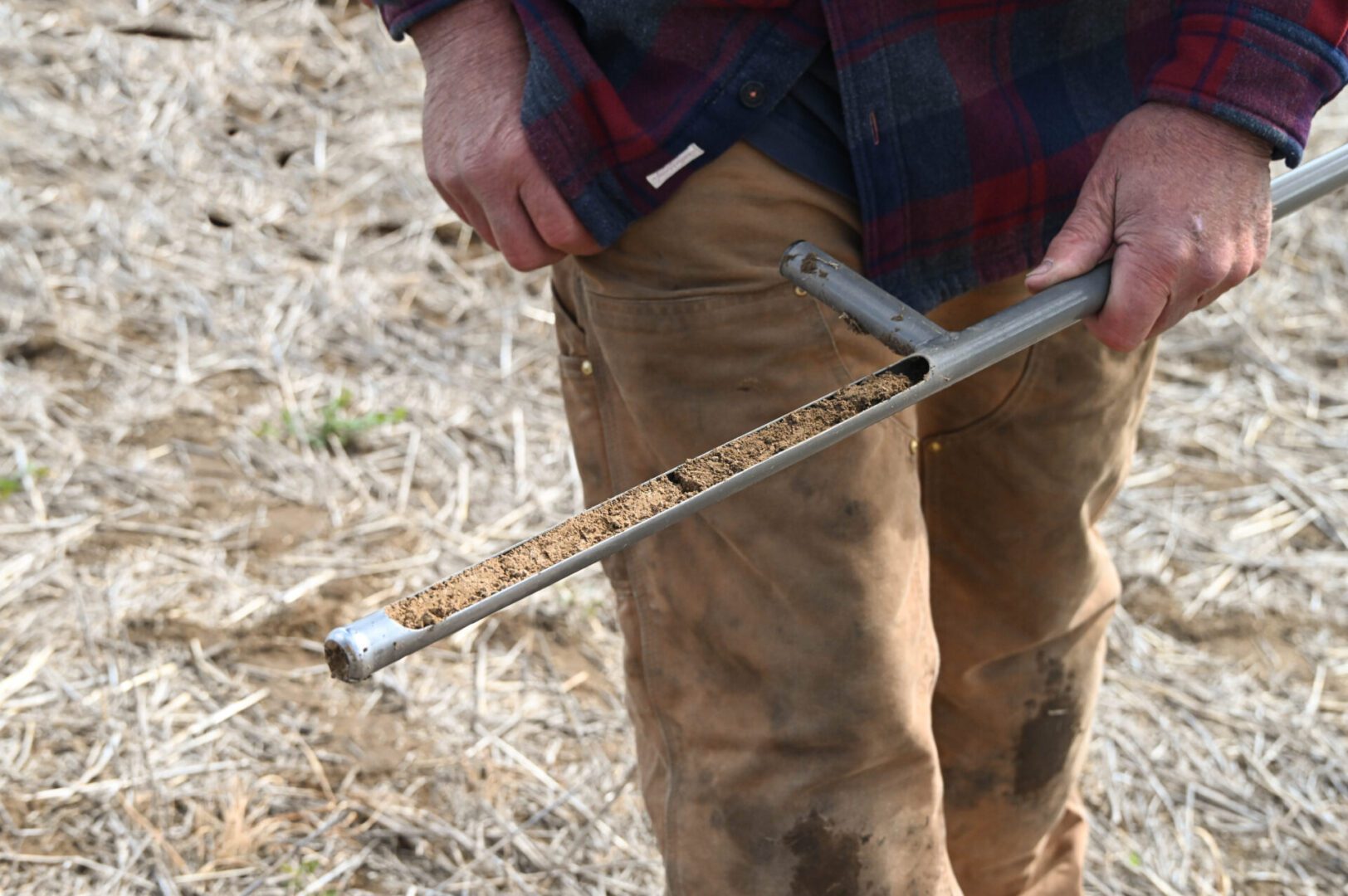
I started spreading straw about ten years ago to try to increase organic matter on the eroded hilltops. After a couple of years, I tried blending in compost, and I saw immediate results. Compost is like a ready-to-eat meal for the plants, it’s already decomposed and goes right to plant nutrition.
When we spread compost in the fall and seeded barley the next spring, the difference was obvious, the barley was taller, healthier, and easier to harvest. I would absolutely recommend compost, it works. I can show you the results in my fields.
What have been the biggest challenges to apply compost on your farm?
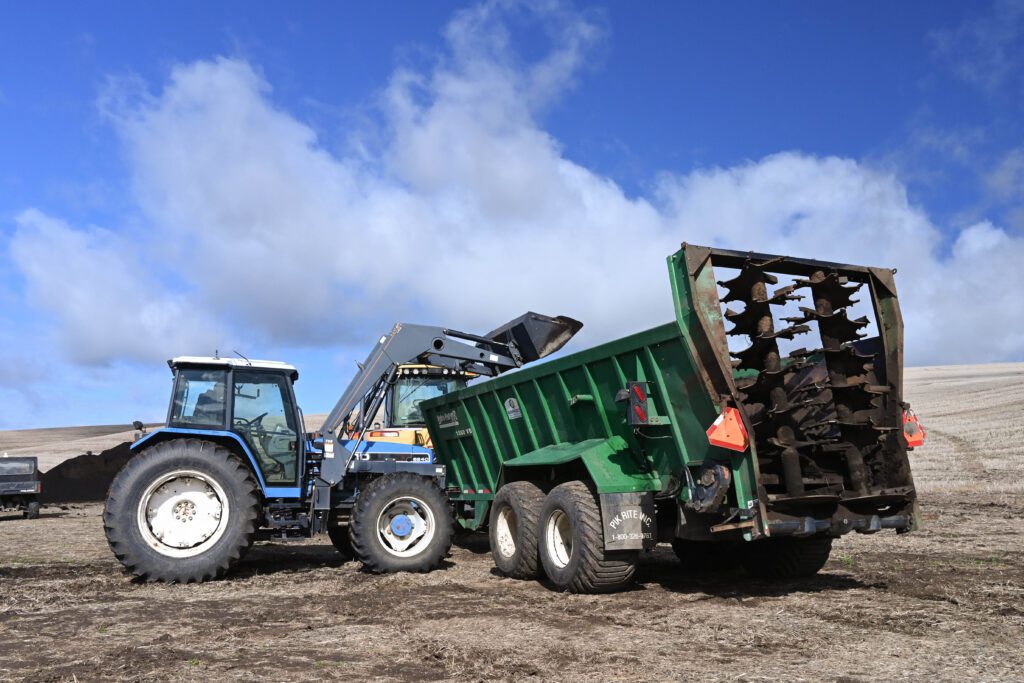
Applying compost has not been easy, you need to have the equipment and a way to get the material delivered and spread, you’ve got to have the time, and you’ve got to be ready when the weather is right. Probably the biggest challenge when we started using compost was the timing. We were always trying to do it in the fall, usually on winter wheat stubble, and we’d wait until the very last second when the weather was getting bad. Sometimes we’d get iced out by weather and we've had to stop spreading because the ground froze, because it rained too much or because it snowed.
It's a heavy load: a 45,000-pound tractor and approximately 45-50,000 pounds of implement. We’ve had a couple incidents trying to spread in inclement weather, so that scared us for a while. But now, we're spreading it in May or June, and it's easier to get around with the big implements when the ground is drier.
What benefits have you seen since applying compost?
If we put compost on in the fall and seeded barley the next spring, the barley was better that year. Even if only a few acres improve, it pulls up the average yield of the whole field. A patch that used to yield 15 bushels might be 50 bushels now, and that changes everything.
I can tell you for sure that I don’t have to run the header in the dirt anymore. Before we started applying compost on the hilltops, we were scraping to get the crop harvested because it was so short. Now the grain is tall enough that you can cut it clean. That’s a big deal.
What would you tell other farmers?
The cost scares people. If we apply at a rate of 20 tons per acre, and it’s $24 a ton with delivery, it’s well over $400 per acre. But you don’t have to do the whole field. Improving just a few acres can bring up the yield average of the whole field. The fields have good dirt with high organic matter already, so I just focus on the eroded hilltops. Out of a field of 100 acres, I might do 10 acres, just trying to reinvigorate the hilltops. If you amortize that over the entire farm on a per acre basis, it's not much because the flats don't need it.
I'm also not applying compost to every field every year. I might apply once every four years. So that brings the cost down as well. But yeah, the upfront cost is staggering. When there's funding opportunities, jump on them. That's what they're there for.
Pay attention to what other farmers are doing, especially the innovators and neighbors willing to try new things. If something works, I want to know about it. If something fails, I want to avoid that mistake.
Soil health practices might look different on every farm, but they all come from that same desire to make the land better.
The results are there; you just have to be willing to make it part of your operation. Improving the soil is a decades-long process, and you can’t expect overnight results. Sometimes you just have to go with your gut and try it.
To learn more about Doug and Erin Schuster:
- Listen to the PNW Farmers’ Network Podcast featuring Doug & Erin
- Watch Washington Grown segment to learn more about how Doug and Erin are applying compost.
- Check out the Inland Northwest FLOURISH project for more information on how Doug and other dryland wheat producers are improving their soil health through cover crops and livestock integration.
If you or someone you know would like to participate in our Soil Health Ambassador Program, email Leslie Michel at lmichel@agr.wa.gov
Special thank you to the Palouse Conservation District for collaborating on filming and providing video footage at the Schuster Farm.
Want to connect with Doug?
Fill out the form below

Leslie Michel
Leslie works with counties on the Voluntary Stewardship Program through the Washington State Department of Agricutlure, providing technical support on their monitoring plans. She also assists with the Washington Soil Health Initiative and Sustainable Farms and Fields program by providing support for soil sampling.
This article was published by the Washington Soil Health Initiative. For more information, visit wasoilhealth.org. To have these posts delivered straight to your inbox, subscribe to the WaSHI newsletter. To find a soil science technical service provider, visit the Washington State University Extension website or the Washington State Conservation District website.