

Updates From the Irrigated Columbia Basin Potato Systems LTARE
Learn what's happening at WaSHI's long-term research site focused on irrigated potato cropping systems in the Columbia Basin.
Authors: Madeline Spets and Ashley Spradling
June 4, 2026
Why This Site Matters
The WaSHI Long-term Agroecological Research and Extension (LTARE) trial in Othello, WA is evaluating the effects of fumigation, compost application, and cover cropping on agricultural production in the irrigated Columbia Basin.
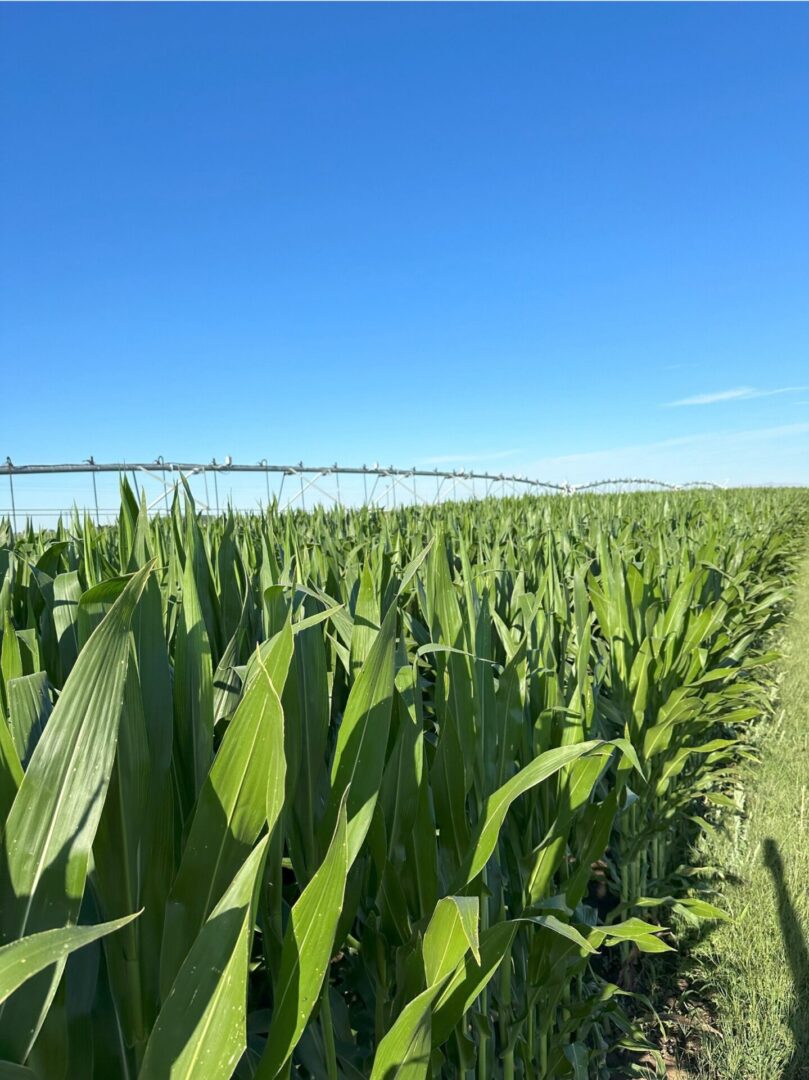
The objective of this research is to produce scientifically supported information on the effectiveness and interactions of these management practices, ultimately providing agricultural growers with reliable data to inform decision-making and improve long-term crop production and resource management.
In agricultural systems, maintaining soil health can improve water infiltration and retention, reduce input requirements, and support long-term productivity and sustainability. Practices such as compost application, cover cropping, fumigation, and reduced soil disturbance are commonly used to enhance soil biological activity and organic matter content, both of which are key indicators of healthy soil function.
Research on soil health provides valuable information to agricultural growers by helping identify management practices that improve crop performance while promoting environmental stewardship and long-term resource conservation.
Experimental design
Growers in the Columbia Basin face unique challenges—soil-borne diseases, declining soil health, and the need for sustainable nutrient management under irrigation. The Othello LTARE trial focuses on three conservation practices identified by stakeholders as practical and impactful:
• Fumigation (+/-) using metam sodium, a common disease management tool with potential soil health trade-offs.
• Compost application (+/-) to build organic matter, improve cation exchange capacity, and stimulate microbial activity.
• Cover cropping (+/-) with diverse species mixes, including biofumigant crops like mustard, to enhance carbon inputs and soil resilience.
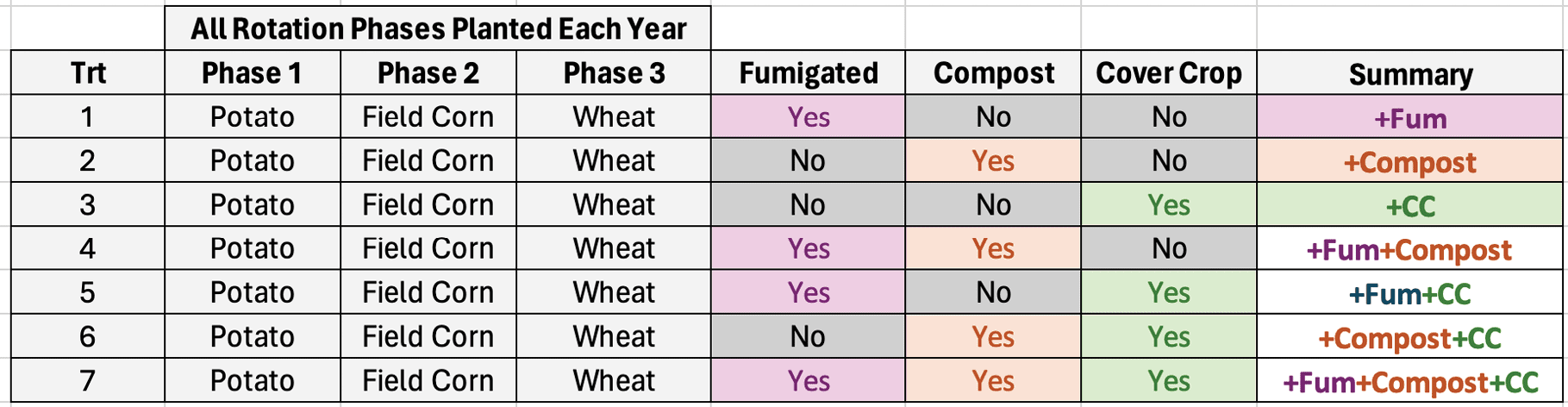
These practices are tested in all possible combinations, plus a true control, across an eight-treatment split-plot design with four replications at the WSU Honey Bee Farm in Othello. The rotation includes potatoes, field corn, and spring wheat, ensuring each crop is present every year.
The site features three crop ranges and four replications aligned with irrigation spans. There are eight plots per replication, each measuring 30 ft (E–W) by 20 ft (N–S) with buffers between east-west plots. Plots are arranged in split-plot format, where main plots contain fumigation treatments and subplots contain compost and cover crop combinations. This design ensures robust statistical analysis while reflecting real-world management constraints.
Trial Reset and System Improvements
In early 2026, the original irrigation system was converted from a linear design to a center-pivot system due to operational limitations of the linear setup. The center-pivot system was implemented to provide more precise and uniform water applications, thereby improving the consistency and reliability of experimental conditions and data collection. As a result of this change, the experimental plots will need to be redesigned to conform to the pivot's circular irrigation pattern, replacing the current straight-block orientation used under the linear irrigation.
To maintain experimental consistency and avoid confounding effects from altered water distribution patterns, the trial will undergo a full soil reset and be re-established in 2027. This restart will ensure that all treatments begin under uniform baseline conditions in the new pivot-aligned configuration.

The transition to the new system is expected to improve irrigation consistency across the study area and better reflect the hydraulic and spatial characteristics of center-pivot irrigation.
Before re-establishing the soil health trial, wheat was planted as a uniform cover crop to standardize soil conditions across the field before implementing the new experimental layout. Establishing a consistent baseline is an important step before reapplying treatments under the redesigned center pivot.
Next steps
Beginning in the fall of 2026, the first phase of treatment application will begin, including mustard-planted plots, fumigation treatments, and compost-amended plots. These treatments are intended to evaluate contrasting soil management approaches and their effects on soil health, nutrient dynamics, and crop performance in irrigated production systems.
The crop rotation phase of the trial will resume in 2027 with the planting of potatoes and corn. Reintroducing these rotational crops will enable researchers to assess how the newly established soil treatments affect productivity, soil biological activity, and overall system resilience under the updated irrigation and plot design.
Learn more about the Irrigated Columbia Basin Potato Systems LTARE site here!

Madeline Spets and Ashley Spradling
Madeline Spets and Ashley Spradling are farm technicians at the WaSHI Irrigated Potato LTARE site.
This article was published by the Washington Soil Health Initiative. For more information, visit wasoilhealth.org. To have these posts delivered straight to your inbox, subscribe to the WaSHI newsletter. To find a soil science technical service provider, visit the Washington State University Extension website or the Washington State Conservation District website.