
WaSHI Annual Report FY25
Sustainable Farms and Fields
This fiscal year marked the SCC’s third year of Sustainable Farms and Fields ongoing funding. In FY25, $1.2 million was allocated to support 36 projects across 20 Washington conservation districts. You can see a complete list of funded projects in the Sustainable Farms Fiscal Year 2025 report on the SCC website.
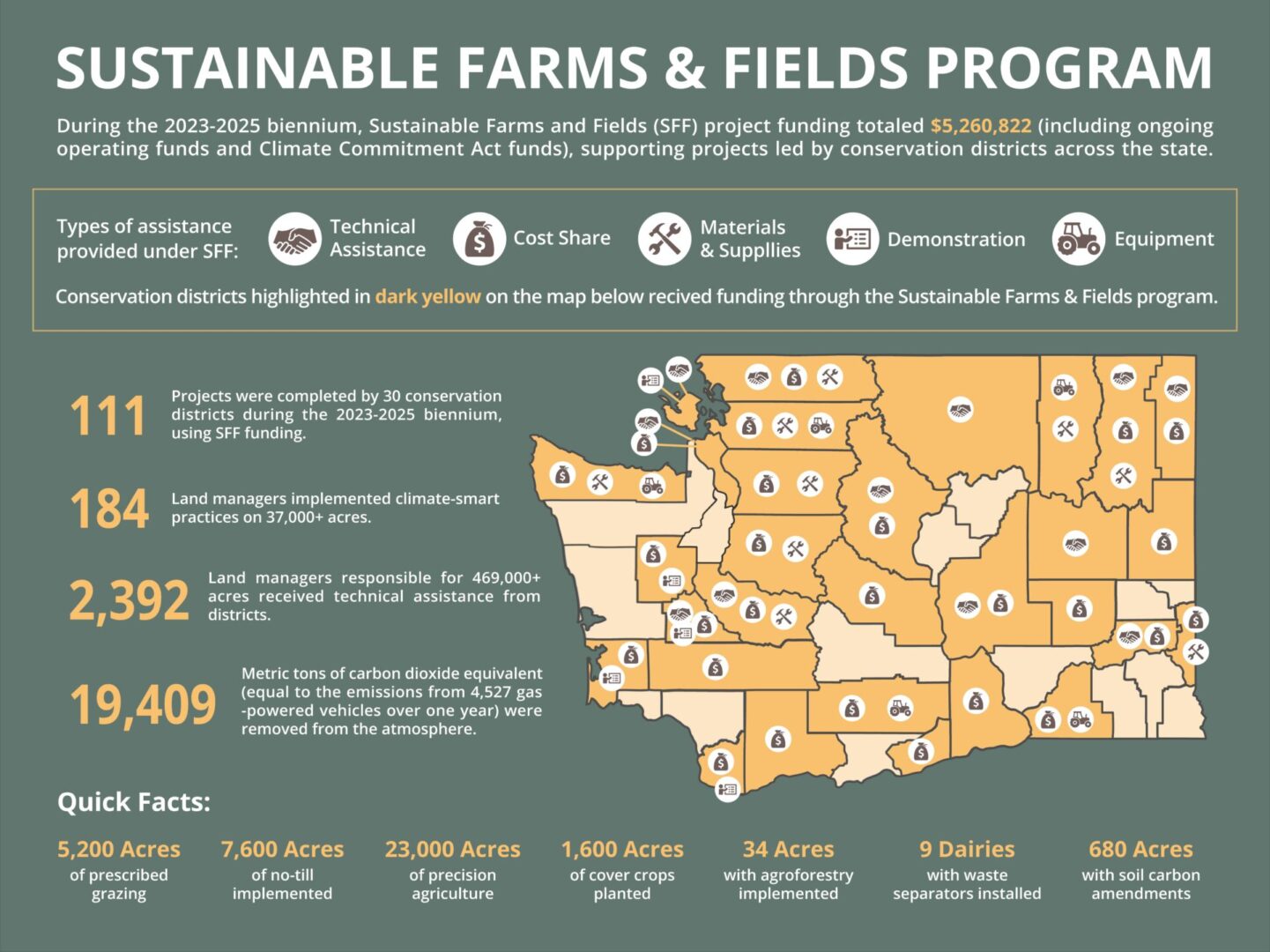
The year 2025 also marks the close of the 2023-2025 biennium. Over the biennium, SFF funding directly resulted in 184 land managers implementing climate-smart practices on over 37,000 acres with an estimated collective impact of 19,409 metric tons carbon dioxide equivalent (CO2e) – equivalent to taking 4,527 passenger vehicles off the road for one year. This funding also resulted in 2,392 land managers responsible for over 469,000 acres receiving technical assistance. Many funded projects involved collaboration among conservation districts. For instance, Snohomish Conservation District took the lead at development of carbon farm plan templates for use in future technical assistance and Pacific Conservation District led an effort to identify climate-smart best management practices relevant to shellfish producers. See the infographic on the next page for a more detailed report of program impacts over the biennium.
The SCC also contributed to two legislative reports related to SFF in FY25. SFF one-time proviso funding of $30,000,000 in 2023 from the Climate Investment Account supports emissions reduction through climate-smart livestock management. The first legislative report, titled Impact of Climate-Smart Livestock Management Proviso Funding in Washington, summarizes the grants awarded and the likely annual greenhouse gas emission reductions achieved as a result of funded projects. As of December 1, 2024, $4.5 million had been allocated to fund 51 projects across Washington state with a focus on climate-smart livestock management.
The Washington State Legislature tasked the SCC with reviewing “the current contribution that organic and climate-smart agriculture makes towards Washington’s climate response goals, the potential there is for increasing this contribution, and how additional investments will help realize this potential, while supporting resiliency.” The result is a second legislative report titled Organic and climate-smart agriculture: Contribution towards Washington State climate response goals. The literature review and report of agriculture stakeholder perspectives revealed strengths and shortcomings of SFF. Growers noted that although the program provides valuable financial assistance to support new practices, the grant funding cycle does not align with the growing season, making it difficult to access and utilize funds when they are most needed.
In the next fiscal year, SFF will continue to support additional projects with a positive impact on soil health and greenhouse gas emissions reduction implemented across the state. We look forward to engaging with conservation districts and other partners on this critical work. To keep up to date with this effort and all things Sustainable Farms and Fields, please sign up for our email list on the Sustainable Farms and Fields website.
Sustainable Farms and Fields Legislative Reports
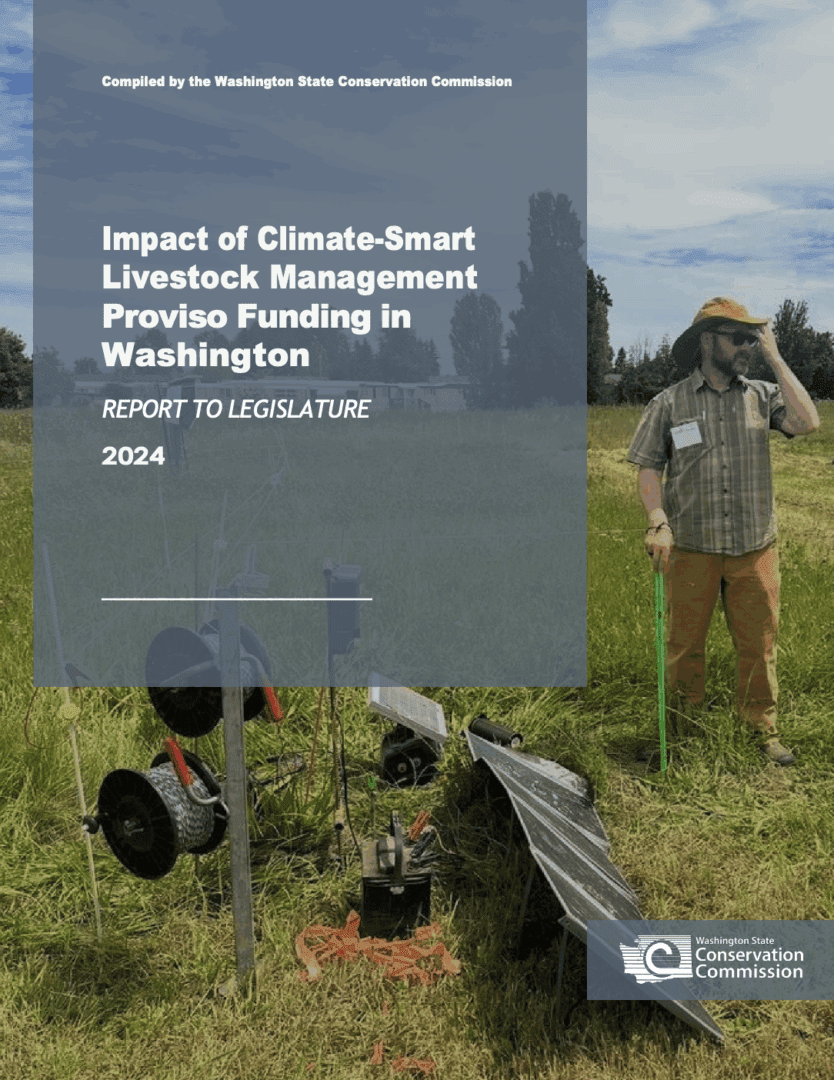
Impact of Climate-Smart Livestock Management Proviso Funding in Washington
The Washington State Conservation Commission implemented a portion of the funding from a one-time proviso focused on Climate-Smart Livestock Management appropriated during the 2023 legislative session. A summary of implementation of these funds through Sustainable Farms and Fields (livestock-specific), Alternative Manure Management, and Research and Demonstration project funding is available in this Report to the Legislature from Dec. 2024. The projects listed in this report will finish in June 2025.
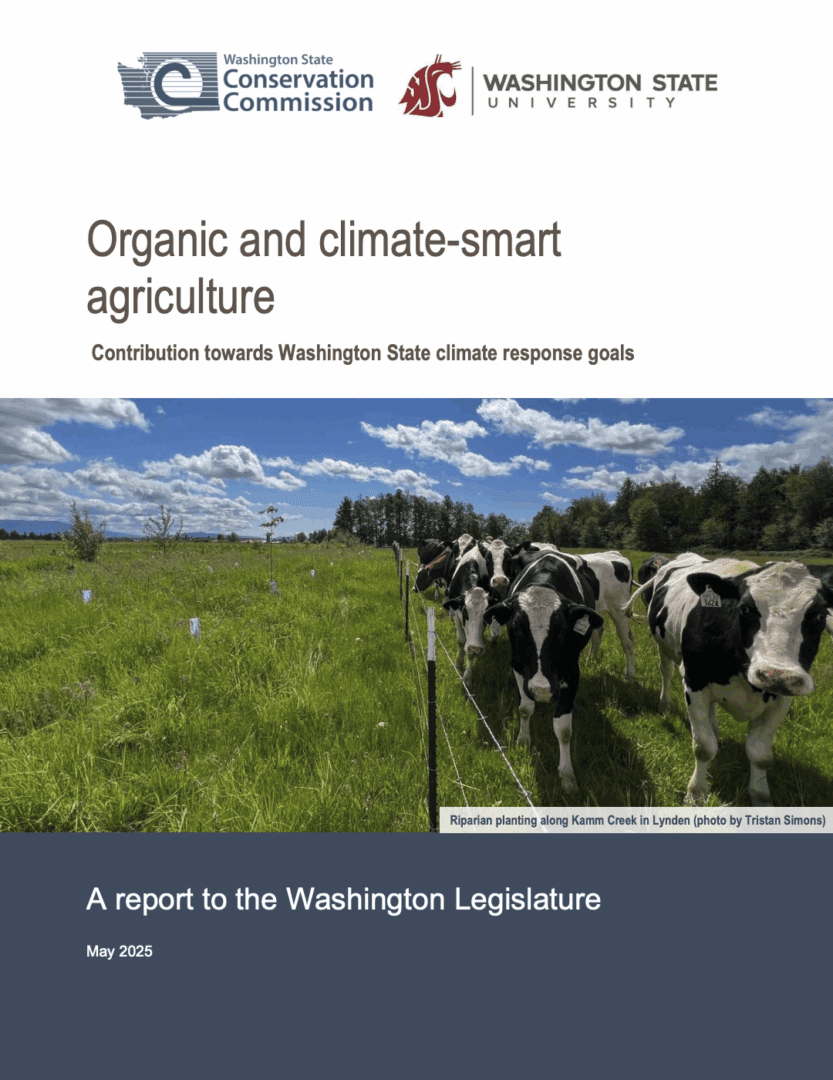
Organic and climate-smart agriculture: Contribution towards Washington State climate response goals
Washington state’s agricultural sector has strong potential to help meet our state’s climate goals through voluntary reductions in greenhouse gas emissions. In response to a request from the Legislature, the Washington State Conservation Commission partnered with Washington State University and KR Creative Strategies to evaluate the current and potential role of organic and climate-smart agriculture. This report includes scientific research and input from producers and agriculture partners, which are highlighted throughout the document.
This opportunity is supported with funding from Washington’s Climate Commitment Act. The CCA puts cap-and-invest dollars to work reducing climate pollution, creating jobs, and improving public health. Information about the CCA is available at www.climate.wa.gov.


Karen Hills
Washington State Conservation Commission