
WaSHI Annual Report FY25

Central WA Tree Fruit Systems LTARE

Wenatchee, WA

A field scene showing three individuals working with a large piece of agricultural equipment mounted on a black trailer. The machine is blue and labeled “Kincaid,” with a wide flexible hose extending downward, dispersing chopped green plant material onto the soil surface. One person stands near the hose, guiding the material, while two others are positioned on the trailer near stacked bundles of green forage. The background features rows of orchard trees and dry, tan hills under a clear sky, suggesting a semi-arid region. Brightly colored flags mark spots in the soil near the foreground.
Figure 1. Researchers applying chopped orchard grass hay to experimental plots in August 2024. The hay serves as a carbon source for microbes who produce volatile compounds toxic to soilborne pathogens under flooded conditions.

The Washington Soil Health for Tree Fruit Long-Term Agroecological Research and Extension (LTARE) had an exciting year. Researchers planted two new trials between June 2024 and July 2025 year and collected the second full year of data on trial 1 established in 2023.

Research Objectives

The Washington Soil Health for Tree Fruit LTARE aims to develop and evaluate management systems that optimize fruit yield and quality through sustainable soil health management practices. Project goals include: identifying soil health best management practices that will 1) reduce fruit disorders related to nutrient uptake and water/plant stress; 2) conserve water and buffer environmental stress, and 3) identify long-term sustainable management for soil borne disease and nematodes.

Experiments

Trial 1 and 3 (LTARE1, LTARE3) investigate practices to build soil carbon, reduce variability, conserve water, and buffer environmental stress with organic matter applications.

Trial 2 (LTARE2) investigates soil amendment-based strategies designed to mitigate apple replant disease.
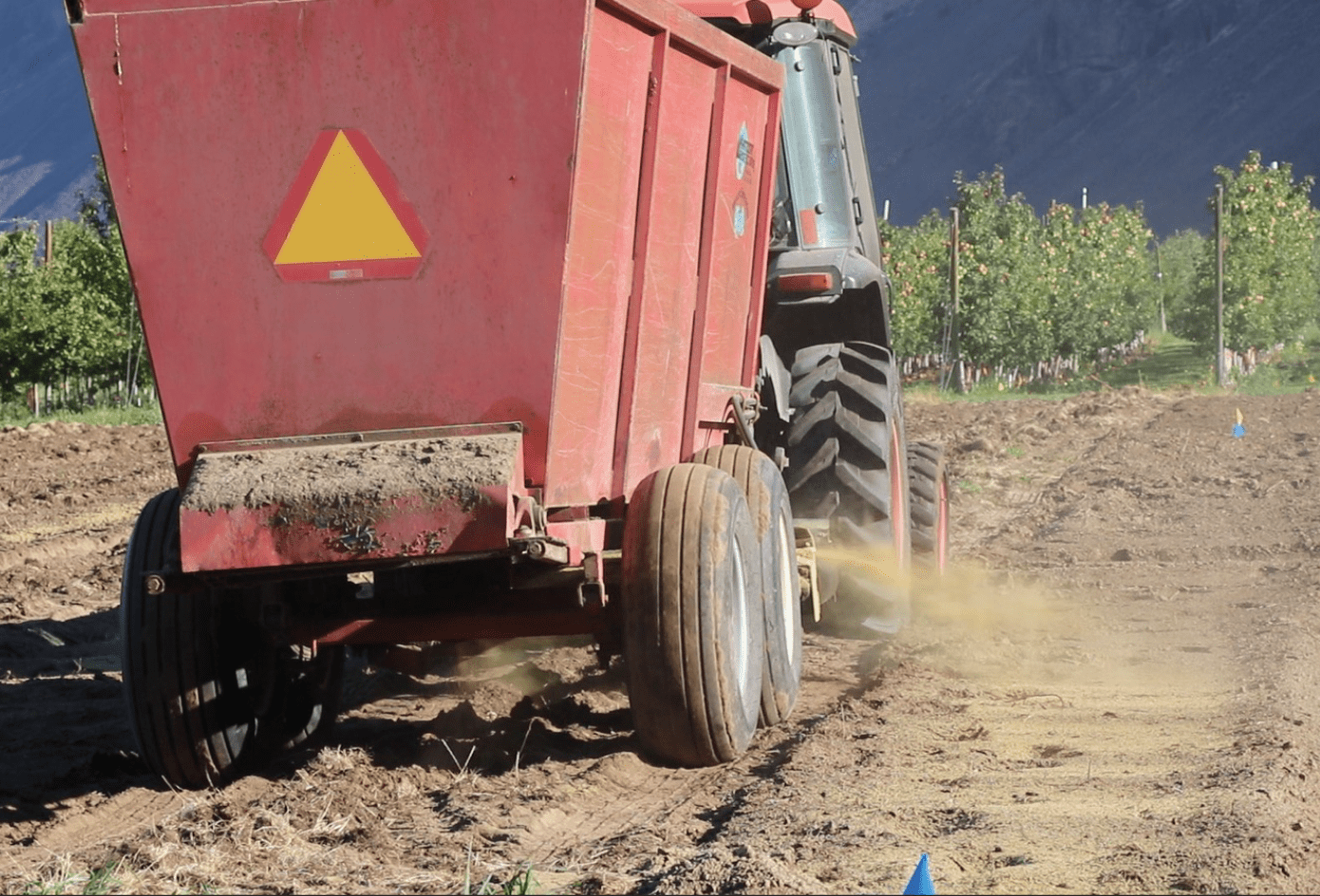
A red agricultural spreader attached to a tractor moves along a bare soil row in an orchard. The spreader has a large triangular reflective sign on the back and is releasing a light stream of material, creating a dusty effect on the ground. The orchard rows with green trees are visible to the left and in the background, while blue marker flags line the soil in the foreground. Behind the orchard, steep, rocky hills rise under clear skies, indicating a semi-arid landscape.
Figure 2. Brassica seed meal application in experiment 2 August of 2024. Brassica seed meal releases volatile compounds toxic to soil borne pathogens and nematodes when incorporated into the soil.
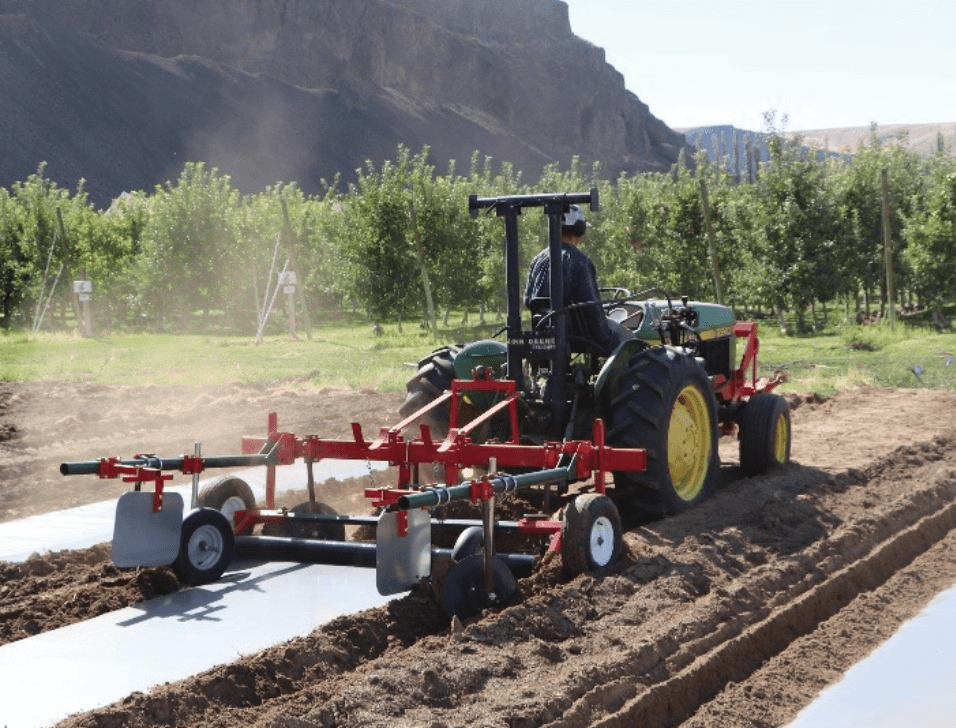
A tractor pulls a red implement designed for laying plastic mulch over raised soil beds in an orchard. The machine has multiple wheels and metal arms guiding the plastic sheets onto the soil, creating smooth, covered rows. The tractor is green with yellow wheels, and the operator is seated facing forward. In the background, there are rows of green orchard trees and steep rocky hills under a bright, clear sky. The soil in the foreground appears freshly tilled, with two plastic-covered beds already in place.
Figure 3. Researchers tarping soil after treatments were applied to soil in August 2024. Tarps are impermeable to the volatile compounds produced brassicas in the brassica seed meal treatment and by microbes under anaerobic conditions in the anaerobic treatment.

Experimental Progress

Fall 2024

• Annual soil and rhizosphere sampling was conducted in the fall of 2024 for LTARE1 including measurements of biological, physical and chemical properties. Measurements included soil carbon, microbial communities and nematode soil food web indicators.

• Tree diameter was measured in the fall 2024 in LTARE1 to track tree growth.

• Treatments for experiment 3 (LTARE3) were applied in fall 2024 and spring 2025 to experimental plots in a 2.5 acre orchard. A high carbon treatment (Carbon) and organic treatment (Organic) was initiated with 10 tons per acre of compost applied in the fall. The mulch treatment was initiated in the spring with a 2 to 3 inch deep layer of apple wood chips.

Spring 2025

• LTARE2 was planted to apple cultivar gala on G.41 and M9.337 rootstock in April 2025 (Figure 4). Activities to establish the planting included removing rocks, preparing the soil, constructing trellis, planting trees and training young trees.

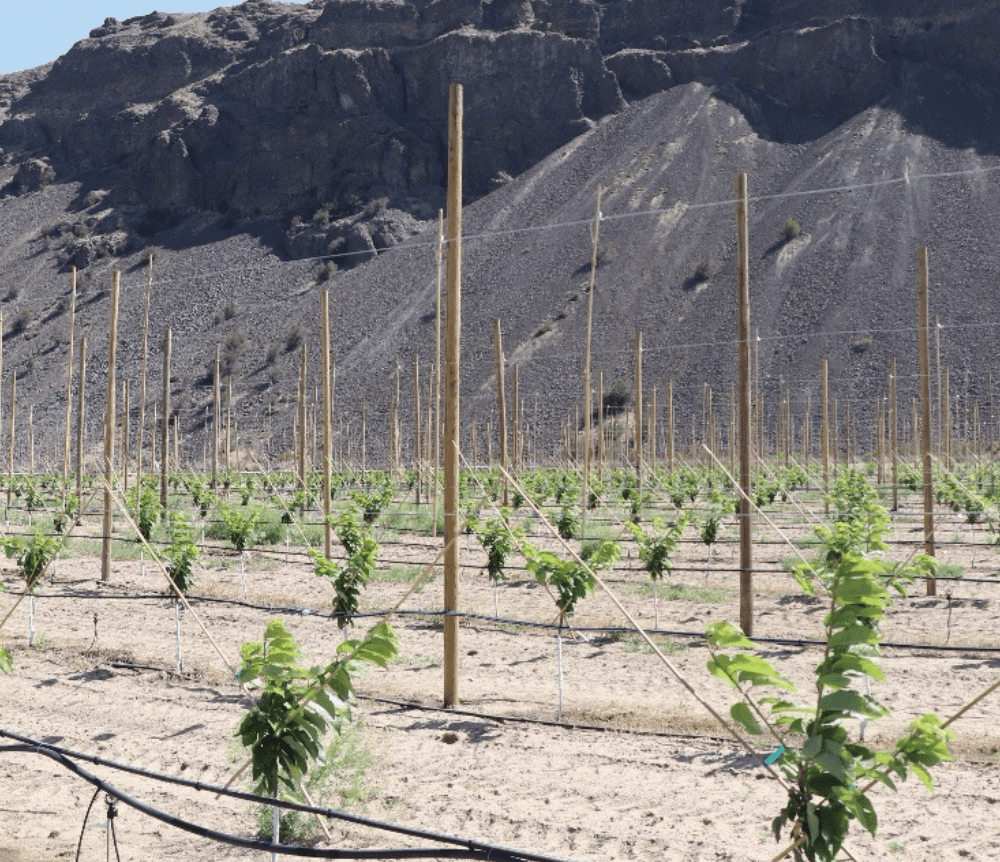
• LTARE3 was planted with cherry cultivator Skeena on Gisela 12 rootstock in April 2025 (Figure 5).  Activities to establish the planting included installing the irrigation system, preparing the soil, constructing trellis, planting trees and training young trees.

• Baseline soil sampling was conducted in the spring of 2025 for LTARE2 and LTARE3 including measurements of biological, physical and chemical properties. Measurements included plant parasitic nematodes, soil borne pathogens linked to apple replant disease.

• Tree diameter was measured in new experiments LTARE2 and LTARE3 in the spring to establish their initial size.

• Soil moisture was tracked throughout the growing season in each treatment for LTARE1.

Summer 2025

• Tree stress measurements were conducted every other week in June and July in LTARE1

• Treatments for experiment 2 (LTARE2) were implemented in August 2025 to experimental plots in a 2.5 acre orchard (Figure 1 to 3). Treatments include  anaerobic soil disinfestation (ASD), Brassica seed meal (BSM) soil amendment, fumigation (FUM) and a no treatment control (CON).
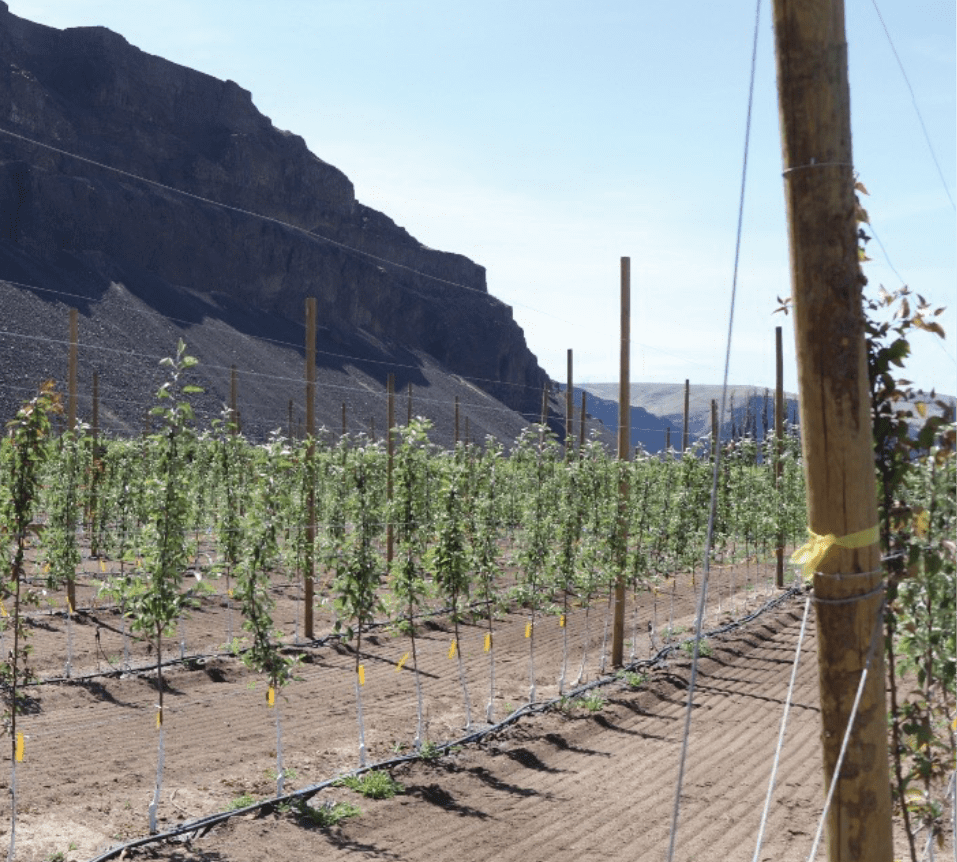
Rows of young orchard trees are planted in a neatly prepared field with bare soil and drip irrigation lines running along each row. Tall wooden stakes support the trees, and trellis wires are visible overhead for training. The orchard is set against a dramatic backdrop of steep, rocky hills under a bright blue sky, indicating a semi-arid environment. The trees are evenly spaced and appear to be recently established.
Figure 4. Gala apple trees newly April 2025 planted in soil treated with anaerobic soil disinfestation, LTARE2. Pictured June 2025.
A newly planted orchard with rows of young trees spaced evenly across bare, sandy soil. Each tree is supported by tall wooden stakes and connected to trellis wires for training. Drip irrigation lines run along the rows, providing water to the plants. The background features steep, rocky hills under a clear blue sky, emphasizing the semi-arid environment. The trees are small but show healthy green foliage.
Figure 5. Skeena cherries newly planted in April 2025 into experiment 3 (LTARE3). Soil in high carbon and organic treatments had 10 tons per acre of compost applied and will receive additional carbon from grass mown and blown from the drive row into the tree row.

Outreach

• We presented our progress at the 2024 Sunrise Research Farm Summer Field Day, attended by 100 participants, and at the 2024 Tree Fruit Soil Health Workshop, attended by 119 participants.

• Our LTARE site was toured by two groups, one from Australia and one from Texas.

• Cumulatively, over 250 people were reached through trainings and tours.

A person with shoulder-length blonde hair is seated outdoors on a yellow chair. The individual is wearing a maroon shirt and dark earrings. The background shows green foliage and blurred plants, suggesting a garden or natural setting on a sunny day.

Tianna DuPont

USDA Agriculture Research Service