Washington Soil Health Initiative Roadmap
Appendix
1
Results from 2020 Irrigated Agriculture Soil Health Survey
Information Collection
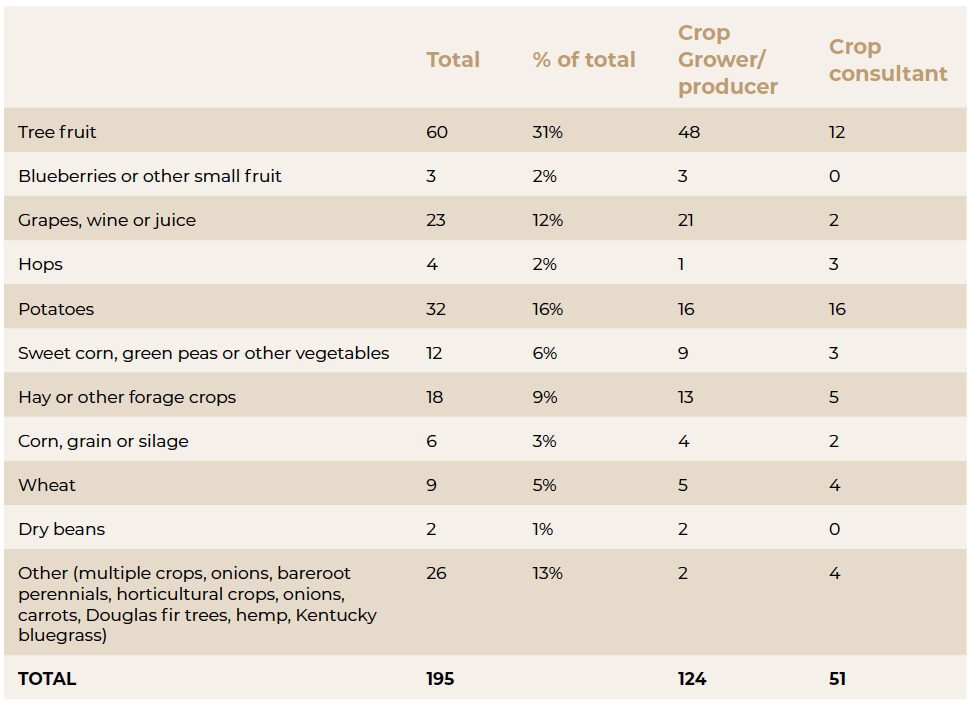
A survey was sent to the Irrigated Agriculture listserv managed by Washington State University Extension on February 13, 2020 and was closed on March 7, 2020. 147 crop growers/producers, 54 crop consultants and 16 livestock producers participated, for a total of 217 respondents across production systems.

Since soil health issues and approaches can vary substantially based on production system, survey responses were divided by primary crop identified by survey participants. Results by crop type are detailed elsewhere in this report.
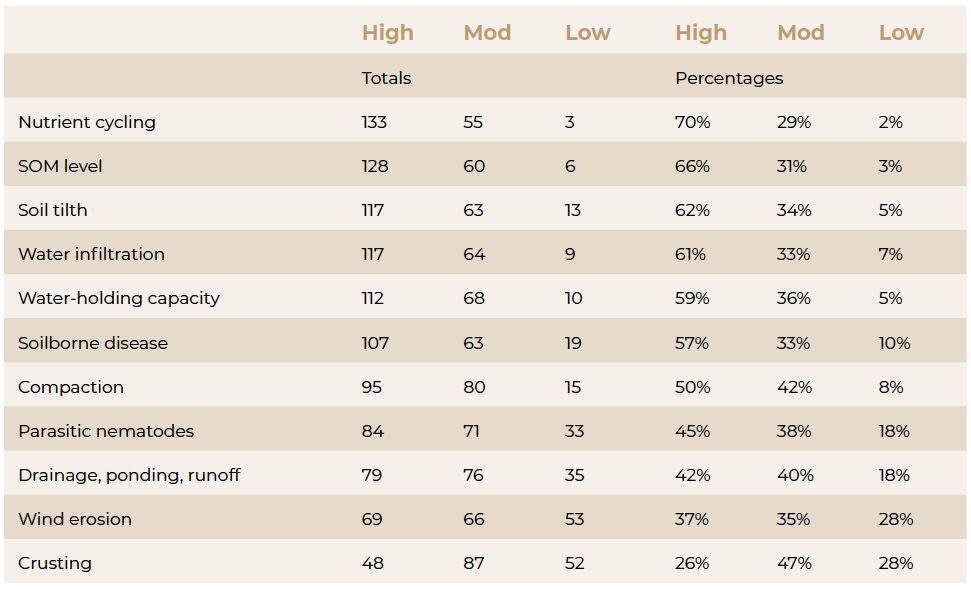
Importance of issues related to soil health – All respondents High
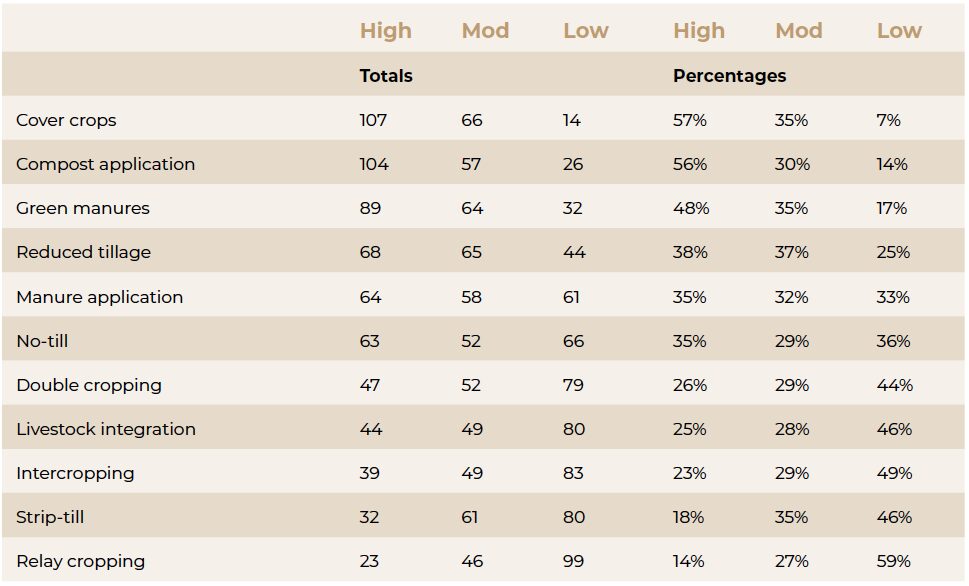
Interest in soil health improving practices – All respondents
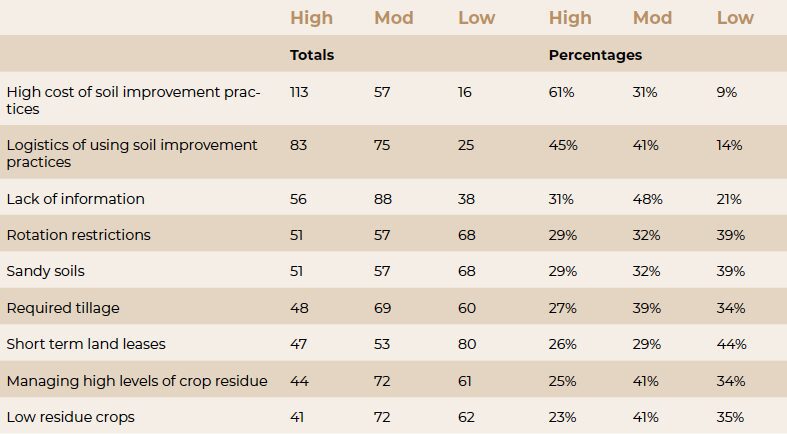
Importance of challenges to improving soil health – All respondents
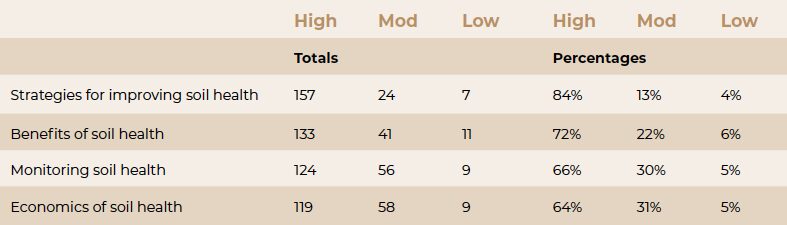
Importance of research or additional information – All respondents
2
Tree Fruit Industry Responses to 2020 Soil Health Initiative Survey
37 respondents representing more than 8,170 acres of apples, pears and cherries.
How would you define soil health?
- Diverse microbial life, abundant organic matter, good water-holding capacity/soil structure, ability to sequester carbon
- Good
- The state at which available nutrients are readily available to the plant
- Group of soil characteristics that enable the sustained growth of trees, organisms and life
- Microbial diversity and abundance.
- Healthy soil feeds itself through a diverse microbiome. The healthiest soils require minimal inputs, other than replenishment of organic material.
- The ability of the soil to continuously maintain a healthy population of diverse beneficial soil microbes and flora to suppress pathogens and mineralize/produce nutrients for the crop.
- Good - but that is an uneducated assessment
- Somewhat okay
- Soils ability to retain and deliver nutrients for healthy crop production. sufficient nutrients in the right chemical state, maintained by the biological community in the soil to feed the plant at its optimal desire.
- Balance of nutrients and microbes to allow us to grow good fruit/ plants
- Not affecting fruit quality
- The virility and vitality of soil environment.
- Good soils would have a active microbial population. For what I grow in it a mid 6 pH is desired. Minerals available.
- Productive healthy living soils
- Poor
- The ability of the soul to provide an environment conducive for the healthy development of plants with an abundant and thriving rhizosphere.
- How well the tree is able to extract nutrients out of the soil, how well it holds water and moisture, biologicals available in the soil.
- humus, PH, texture (sand gravel Loam) microbes, the balance of these with necessary elements.
- Microbial activity is an indicator of soil health.
- How erodible soil is. Microbial activity. Water holding ability. Ability to provide water and nutrients.
- How soil benefits the growth of the trees. Biodiversity.
- Soil that can support plants. Soil holds the tree in place and holds nutrients and water.
- Good organic and microbial population.
- Organic matter.
What are the most important challenges from low soil health to our industry’s orchards?
- Replant disease
- Diseases and therefore huge expenses due to outside inputs, low nutrient dense fruit
- PH
- The ability to quickly, inexpensively and accurately diagnose the issue with the soil health and what specifically to do to achieve a desired outcome.
- Productivity
- Restoring carbon and life to the soil.
- System approach and demands of industrial agriculture ROI push farmers to high input, super high-density systems. These systems are designed to extract resources from the soil, not replenish them.
- Reduced yield potential, seriously reduced fruit quality, increased soil pathogens and diseases, reduced tree health, reduced nutrient efficiency & utilization, all “requiring” more conventional fertilizers and ‘crop protection’ which increases the problems rather than correcting them.
- Pests and nutrient depletion
- it may be organic material in the soil
- Poor industry understanding of basic soil chemistry that has been foisted on industry for generations
- They are not defined and are hard to see.....do they exist
- Rethinking there is more to soil health than just enough nitrogen
- Supplement testing by university.
- Compaction. Infusion of organic matter (lack of).
- What to correct.
- Chemicals for everything
- Developing consistent and uniform crops.
- There are farmers that need to learn to take soil samples and analyze what is happening to their soil, instead of just pumping tons of nitrogen because it is common practice.
- nutrient availability with proper water level and PH.
- Light soils. Can’t incorporate cover crops into the system because of the traffic from sprayers etc. Too much compost can lead to high K. There is not enough biomass available to add for carbon. We can’t just add compost because of the P&K.
- Bitter pit. Low yields. Replant disease. Variability in blocks.
- With weak varieties we can’t afford to let them stop growing, they need to make it to the top wire.
- Nutrient retention and biodiversity.
- Nutrient build-up possibilities.
- Production on hillsides.
- Old lead [arsenic] soil.
3
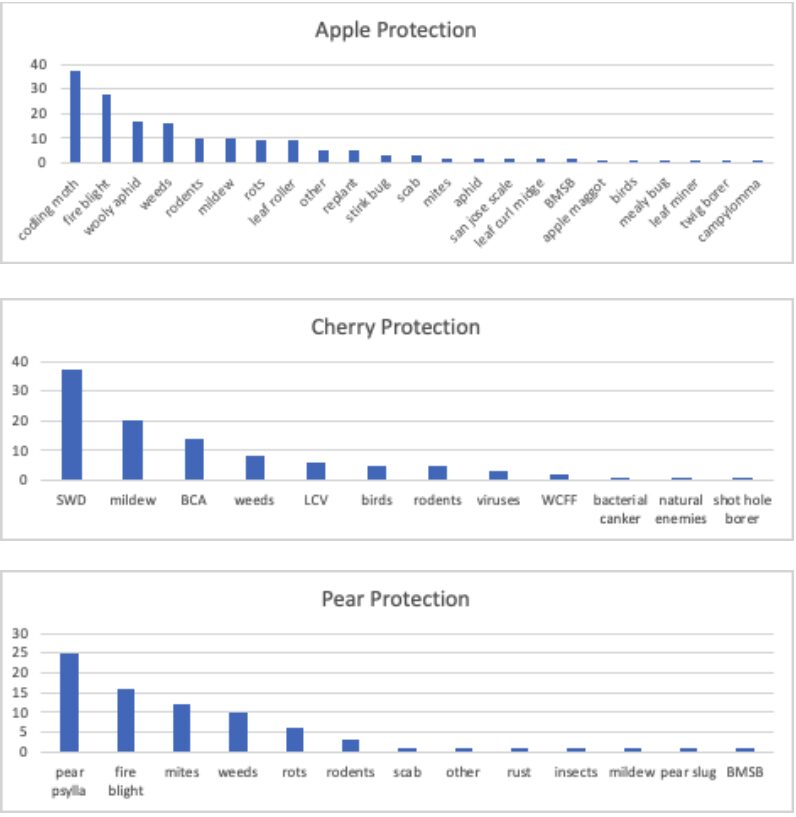
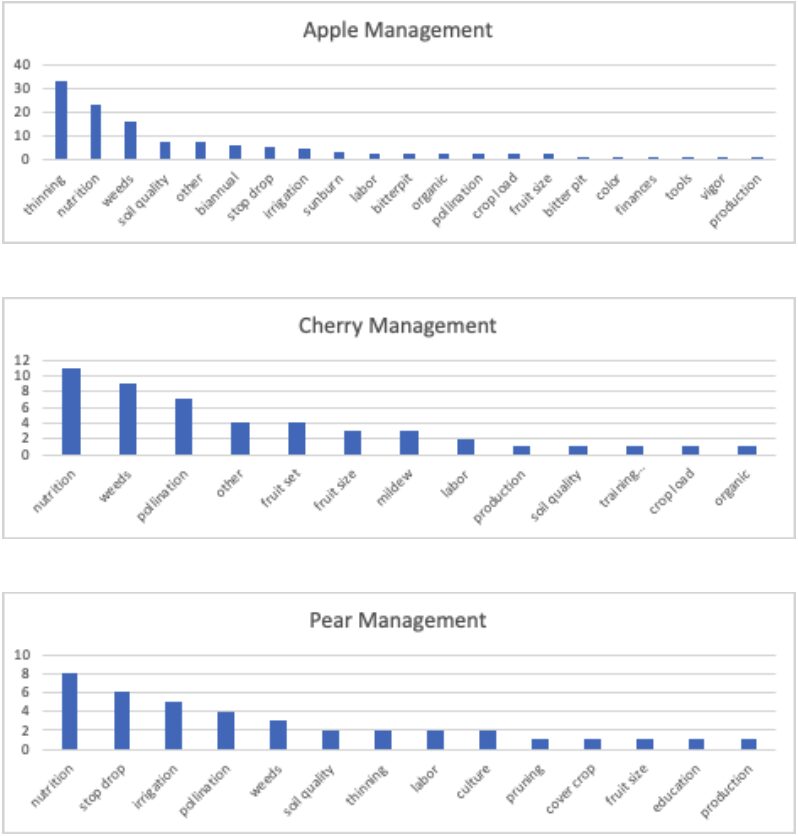
Organic Tree Fruit Producer needs Assessenmt 2017
A survey of organic tree fruit producers was conducted in January to March 2017 by the WSU Tree Fruit Extension team. Producers were asked to list the most challenging issues they face for each organic crop they grow in the areas of crop protection and crop management. Listed below are preliminary results of this survey which had 104 individual respondents.