
Washington Soil Health Initiative Roadmap
Expected Impacts and Outcomes
1
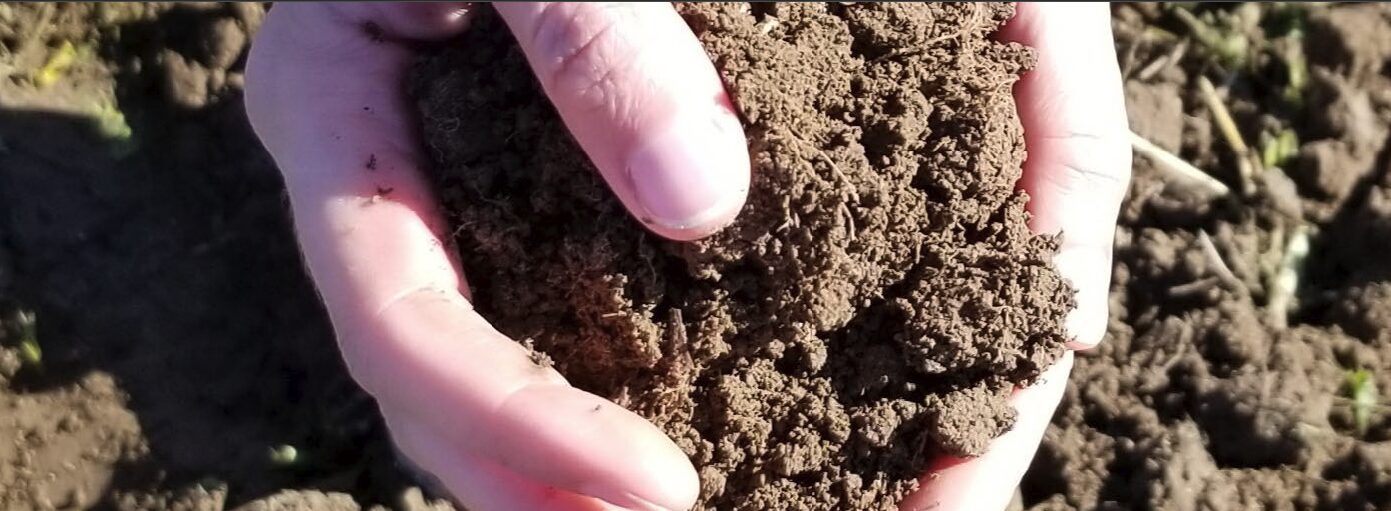
Photo: Kruger
Assuming widespread adoption of agricultural practices that protect or improve soil health, several impacts and outcomes are expected. In the coarse textured soils typically found East of the Cascades, an increase in the use of practices contributing carbon to the soil (e.g., cover crop use, application of organic amendments, maximizing plant residues, reduce tillage/no-till) will lead to increases in soil organic matter content. Resulting from this change, increases in soil water and nutrient holding capacity. This is especially important in the dryland farming regions, but also for the irrigated systems as timing of peak flow of the Columbia River shifts (e.g., Hall et al. 2016). Adoption of soil-building practices and subsequent increases in soil organic matter also will benefit agricultural production in western Washington. As stated in the Northwestern Washington Annual Cropping Systems focus area, growers realize the important role that soil organic matter plays in reducing issues with compaction and water management.
As outlined across several of the focus areas, use of soil health improving practices can result in several other ecosystem benefits. Reducing erosion and runoff will benefit water and air quality across the state. As documented in the Irrigated Columbia Basin focus area, issues around wind erosion have negatively impacted farmer’s bottom line in addition to the air quality impacts to the non-farming population. In western Washington, water quality issues have detrimental effects on the fishing and shellfish industries, recreation, and to the overall functions of ecosystems.
Making changes to improve soil health in Washington’s agricultural systems will also improve the resiliency of the food system across the state. Food system resiliency has been described and defined by many (e.g., Schipankski et al. 2016, Tendall et al. 2015) and contains many facets including production. As the past year has revealed, we are experiencing a changing climate. Greater temperature and moisture fluctuations and increases in the frequency of extreme weather events can be expected in the future. These expected changes highlight the importance of building the resilience of Washington’s food production systems.
The potential for soils to store carbon varies, but taken as a whole, soils can act as major sink for atmospheric carbon (Lal et al. 2007). Widespread deployment of soil health practices can lead to increases in soil carbon, mitigating climate change impacts, and offering a potential source of revenue for landowners as carbon markets mature. With statewide programs such as the Sustainable Farms and Fields Program recently funded, landowners have increased options to undertake soil health improving practices.
Washington State’s agriculture is extremely diverse producing over 300 different commodities (USDA NASS 2019). 63% of the total value of agriculture products come from exports that rely on access to water and healthy soils. Threats to this sector can be witnessed during windy spring conditions as fields are prepared and wind erosion events take place or during heavy precipitation events as eroded soils enter adjacent waterways.
Healthy soils can positively influence agricultural production while protecting vital natural resources. More specifically, factors that reduce yield can be mitigated through practices that improve soil health leading to increased economic benefits to farmers. As this occurs, farmland can sequester carbon, and protect air and water quality. The State of Washington is at the beginning of the Washington Soil Health Initiative that will utilize an integrated approach to improve the health of soils in the state. With widespread education and adoption of practices that maintain or improve soil health, this effort will be a win-win-win situation for farmers, environmental advocates, and the residents of Washington State.
2
References
- Hall, S.A., J.C. Adam, M. Barik, J. Yoder, M.P. Brady, D. Haller, M.E. Barber, C.E. Kruger, G.G. Yorgey, M. Downes, C.O. Stockle, B. Aryal, T. Carlson, G. Damiano, S. Dhungel, C. Einberger, K.Hamel-Reiken, M. Liu, K. Malek, S. McClure, R. Nelson, M. O’Brien, J. Padowski, K. Rajagopalan, Z. Rakib, B. Rushi, W. Valdez. 2016. 2016 Washington State Legislative Report. Columbia River Basin Long-Term Water Supply and Demand Forecast. Publication No. 16-12-001. Washington Department of Ecology, Olympia, WA. 216 pp. Available online at: https://fortress.wa.gov/ecy/publications/SummaryPages/1612001.html.
- Lal, R., R.F. Follett, B.A. Stewart, and J.M. Kimble. 2007. Soil Carbon Sequestration To Mitigate Climate Change And Advance Food Security. Soil Science 172: 943–956. https://doi.org/10.1097/ss.0b013e31815cc498.
- Schipanski, M.E., G.K. MacDonald, S. Rosenzweig, M.J. Chappell, E.M. Bennett, R.B. Kerr, J. Blesh, T. Crews, L. Drinkwater, J.G. Lundgren, C. Schnarr. 2016. Realizing Resilient Food Systems. BioScience 66: 600–610. https://doi.org/10.1093/biosci/biw052.
- Tendall, D.M., J. Joerin, B. Kopainsky, P. Edwards, A. Shreck, Q.B. Le, P. Kruetli, M. Grant, J. Six. 2015. Food system resilience: Defining the concept. Global Food Security 6: 17–23. https://doi.org/10.1016/j.gfs.2015.08.001.
- United States Department of Agriculture National Agriculture Statistical Service (USDA NASS). 2019. 2017 Census of Agriculture. Vol1. Part 51. 820 pages. https://www.nass.usda.gov/Publications/AgCensus/2017/Full_Report/Volume_1,_Chapter_1_US/usv1.pd