
Washington Soil Health Initiative Roadmap
Red Raspberry
1
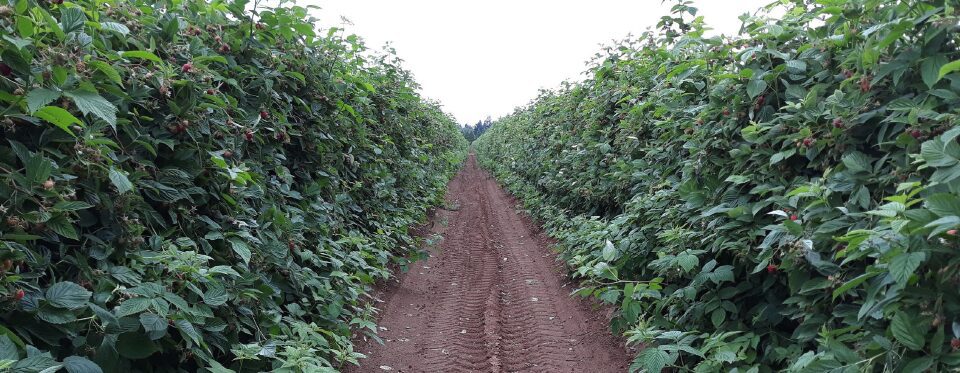
Photo: DeVetter
Primary Authors: Lisa DeVetter, Deirdre Griffin LaHue, Tom Walters, Inga Zasada, and Chris Benedict
Updated: March 2023
Summary
Soil fertility, compaction, and soilborne pathogen and nematode management have been identified as key soil health concerns by growers and crop advisors. Viable solutions are yet to be identified. The industry is interested in long-term soil health research, but availability of suitable land in Whatcom County is a limitation.
Overview
Northwest Washington produces most of the US processed raspberries and comprises 99% of Washington’s raspberry production. The industry is concentrated in Whatcom County with 62 growers cultivating raspberry on ~8,800 acres.
Current Situation
A focus group of raspberry growers and Washington State University, USDA, and private researchers was held in April 2022. A follow-up survey and one-on-one discussions with raspberry growers were held in the Summer of 2022. These events were leveraged to inform this chapter and catalyze future research and outreach efforts on soil health in raspberry systems.
Growers are observing declines in raspberry planting longevity and are associating this decline to soil health and adaptation of cultivars. Soilborne pathogens including plant-parasitic nematodes and Phytophthora root rot are the primary biotic factors impacting raspberry production. Despite fumigation, some growers continue to struggle with managing these soilborne pathogens. Abiotic soil health, particularly soil compaction, was another topic of concern among growers. Cultivation and harvesting entails use of heavy equipment that compacts alleyway soils, which can reduce drainage and may limit root growth. Maintaining or increasing fertility was also highlighted by growers. Most growers apply synthetic fertilizers to meet plant nutrition goals, but industry-specific guidelines on timing, rates for specific cultivars, application techniques, and achieving uptake of key nutrients (e.g., calcium) are lacking. An additional constraint is suitable land for raspberry production is limited and costs for external inputs are increasing. Research has been conducted on soilborne pathogen management, alleyway cover cropping, and compaction through industry support.
However, the industry and perennial nature of the crop requires a more concerted effort to address key soil health issues to ensure the long-term viability of the Washington raspberry industry.
2
Goals and Priorities
During the information gathering process, three goals of the raspberry industry related to soil health were identified: 1) improved control methods for soilborne pests (plant-parasitic nematodes and Phytophthora root rot) without detrimentally affecting other aspects of soil health, 2) methods to reduce soil compaction, and 3) practices that improve or maintain soil fertility. The Washington Red Raspberry Commission (WRRC) identifies priorities annually. The industry has identified four research priorities related to soil health: 1) development of cultivars that are disease resistant, including resistance to soilborne diseases, 2) understanding soil ecology and soilborne pathogens and their effects on plant health and crop yields, 3) soil fumigation techniques and alternatives to control soilborne pathogens, nematodes, and weeds, 4) and improved nutrient and irrigation management.
Improve soilborne pest management
The industry almost exclusively relies on soil fumigation for soilborne pest management prior to replanting. Post-plant fungicides and nematicides are also used. Soil fumigants, fungicides, and nematicides tend to be broad spectrum biocides that not only suppress target organisms but also many nontarget organisms. There is currently no long-term vision for how soilborne pathogens will be managed in raspberry without soil fumigation. While there is a raspberry breeding program at WSU that focuses on breeding for resistance to Phytophthora root rot, such an effort does not exist for plant-parasitic nematodes. Improving soil biology and use of beneficial organisms to suppress diseases is an area of interest among growers. However, there has been little research on how to promote suppressive soils in raspberry and that effort would require a long-term commitment from the industry and researchers.
Primary soil health goals:
- Improved management of soilborne pathogens that maintains or improves soil health
- Methods to reduce soil compaction
- Implement practices that improve or maintain soil fertility
Reduce soil compaction
Soil compaction is also common in raspberry production due to the many passes that are required for applying pesticides for crop protection and harvest activities. Compaction leads to issues with drainage and the need for extensive soil remediation upon the removal of a planting. Practices such as deep ripping have negative long-term effects on soil health. Cover crops have received attention by growers and researchers; however, they are not commonly planted. Expanding the use of alleyway cover cropping through research and education focusing on soil health may increase adoption.
Improving soil fertility
Raspberry requires annual application of fertilizers to maintain growth and productivity. Current nutrient management recommendations are from Oregon State University and are not cultivar specific. Growers are also increasingly applying liquid and foliar fertilizers to meet nutrition goals and there has been little research on the application of these fertilizers. Revising nutrient management recommendations for the Washington industry and relevant cultivars will take concerted research efforts and industry support.
3
Milestones
Part of the 10-year strategic plan for the Washington raspberry industry involves environmental stewardship, which includes soil health. Part of this plan is to build healthier soils that are free from economically destructive soil borne pathogens leading to less reliance on current fumigation practices. This vision would reduce a costly component of producing raspberry leading to increased profits to growers. It would also result in a balanced soil biotic system with the ability to self-regulate soilborne pathogens and potentially improve nutrient cycling. Methods to reduce soil compaction, such as cover cropping, would reduce the need for soil disturbance that are extremely detrimental to long-term soil health and sustain gains that might be realized in creating suppressive soils. Increasing or maintaining soil fertility through more targeted fertility programs would improve plant uptake for sustained crop production while minimizing environmental and financial costs .
Significant knowledge must be gained on long-term strategies to reduce the impact of soilborne pathogens and compaction and address soil fertility concerns. The establishment of a long-term soil health research site within the main raspberry production area of Whatcom County would facilitate this type of research.
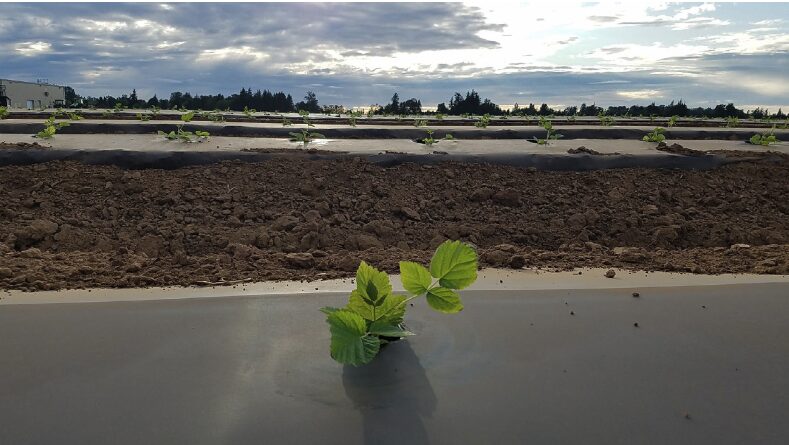
Figure 40. A young raspberry transplant planted into black plastic. (Photo: DeVetter)
Barriers to Adoption
The relative lack of economically sustainable rotational crops reduces the use of crop rotation to improve soil health. Longterm rotations would likely reduce Phytophthora root rot pressure, but very few crops can be grown profitably enough to offset the high land costs where raspberries are grown. The relatively small base of well-drained land with appropriate weather conditions also limits crop rotation.
Due to the high cost of production, raspberry growers can be risk-adverse when it comes to adopting changes that have a high potential to negatively impact production. Expensive inputs, hand labor, and equipment costs combined with highly valuable land are required for commercial production. Any choice that risks a loss of production is very expensive. Practices that improve soil health need to be at least neutral to productivity, and this must be demonstrated to growers. Uncertainty around regulations that could impact fertilization, fumigation, and other soil management practices is also a concern.

Figure 41. Raspberries grown for processing in Whatcom County. (Photo: DeVetter)
Resources/Tools/Opportunities
The raspberry industry in Washington State is well positioned to address the soil health issues that are commonplace. First, WRRC has provided research funds to address issues. These funds are largely considered to be seed funds to begin investigations and to be leveraged for larger grant opportunities. However, projects are funded on a year-by-year basis which prevents long-term projects that are needed to evaluate soil health. Second, the raspberry industry is supported by a research community that extends beyond the state of Washington. Researchers from British Columbia, California, and Oregon have historically addressed the soil health issues through basic and applied research. Third, beyond the support the WRRC provides, many producers within the raspberry community play an active role in supporting research on their farms. These collaborations and connections continue to lead to co-creation of knowledge related to soil health. This strong industry-research community connection underscores a unique opportunity to undertake long-term, on-farm research focused on soil health.
4
Core Investment Areas
The core investment identified by the industry is the need for land in Whatcom County that can be utilized for long-term research to address soil health issues in raspberry. The land must be in Whatcom County due to the specific requirements for commercial production and environmental conditions that the area provides. This research site would provide the opportunity for growers and researchers to implement and evaluate long-term strategies to promote soil health as well as to evaluate new raspberry genotypes produced from breeding programs. Funding is also required for a farm manager to coordinate and maintain a long-term research effort in raspberry.
Agencies such as the NRCS has provided a definition that is used widely. Either there is a lack of the awareness of this definition, or respondents that made this comment don’t agree with it, or soil health metrics are perceived as a definition of soil health.
- Understanding of soil biology.
- Information to translate the current state of soil health knowledge to practical agronomic decisions.
- Understanding of soil health in overall ecosystem function.
- Relationship between soil health and food quality.
- Return on investment (ROI) of soil health practices.
Barriers to Adoption of Soil Health Practices
Description: Barriers prevent the adoption of actions (e.g., management practices, policies) to protect or improve soil health.
- Soils are inherently complex.
- Lack of clarity and consistency of soil health sampling and metrics. Soil health metrics and expected measurement values vary across geography, production systems, and users.
- There is often a weak connection between soil health indicators and economic and environmental outcomes.
- Soil health-promoting practices can lead to unintended consequences (e.g., increased weed pressure and herbicide resistance).
- Producers do not have a good understanding of return on investment of deploying soil health practices.
- Lack of local technical support to deliver production system-specific recommendations.
- Producers are paid to produce crops not to undertake soil health practices, especially in commodity markets.
- Complex, time-consuming incentive programs.
- Complexity of crop rotations.
- Difficulty of investing in soil health practices for leased land.
- Costs associated with soil health practices.
- Logistics of using practices that improve soil health.
- Difficulty of incorporating soil health practices in perennial production systems.
Overcoming the Barriers
Description: Actions (e.g., incentive programs, policy) that would help to overcome the previously listed barriers to adoption.
- Financial incentives for soil health practices that appropriately cover costs.
- Stable, long-term research that connects economic and environmental benefits.
- Increased agency and University capacity and expertise in soil health.
- Implementation of soil health practices needs to be coupled with monitoring.
- Education efforts should simultaneously target K-12, College/University, and landowners and emphasize technical communication.
5
Soil Health Policies
Description: Are there specific state policies that could increase adoption of management practices that improve soil health?
- Incentive programs that reduce the risk for farmer experimentation, provide direct payments for practices that are known to improve soil health, and are not complex or burdensome to farmers.
- Resources available for farmers to try soil health practices.
- Taxes on fertilizers, carbon, and soil erosion
Resources, Tools, and Opportunities
Description: Resources/tools/opportunities that could help advance soil health goals.
- Evaluation of soil health indicators across production systems.
- Coordination with other states and regions.
- Grant dollars from Federal, State, and commodity commissions.
- Technical support with expertise in soil health.
Investment Areas
Description: Strategic investments (e.g., personnel capacity) that could improve soil health knowledge and/or adoption.
- Quantify the value of services provided by soil health improving practices (e.g., crop rotations, cover crops, amendments).
- University research and extension capacity in soil health.
- Funding for long-term experiments that evaluate soil health practices.
- Reliable, simple, universal soil health assessment tools.
- An effective tool to assess soil carbon at scale.
- Inclusion of socioeconomic aspects in soil health research.