
Washington Soil Health Initiative Roadmap
Northwestern Washington Annual Cropping Systems
1
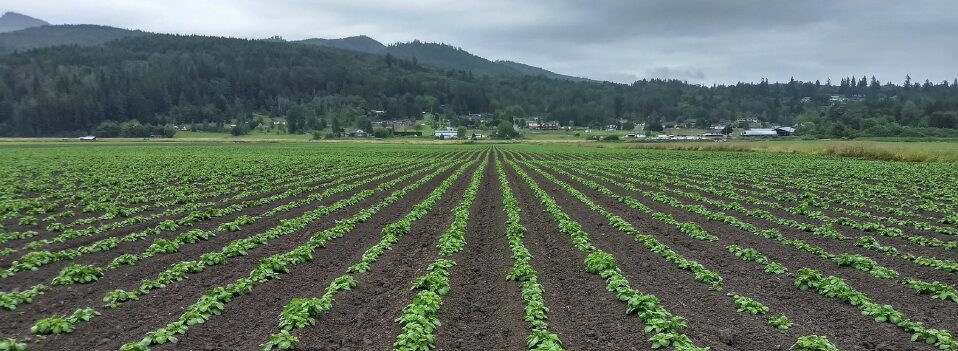
Photo: Griffin LaHue
Primary Authors: Deirdre Griffin LaHue, Gabe LaHue, Karen Hills, Chris Benedict
Summary
In northwestern Washington, crop rotations are diverse but largely driven by the high value of freshmarket potatoes that result in short rotation lengths. Participants mentioned issues associated with intensive tillage and soil pH. Some growers are investigating alternative tillage strategies and changes to rotations. Future research needs to be directed toward quantifying the beneficial value of rotational crops and cover crops and providing better tools to assess changes in soil health. Better understanding of soil biology was also emphasized. Core investments are needed that include biophysical and sociological research related to soil health, standardizing soil health indicators, and long-term monitoring of commercial fields.
Overview
The majority of the following information was gathered at a roundtable event in December 2019 held at WSU’s Northwestern Washington Research and Extension Center (NWREC) in Mount Vernon. There were 22 participants, including growers (14), consultants/agronomists (3), WSDA staff (2), and researchers (3) representing the potato, flower bulb, vegetable seed, small grain, and dairy industries. The event began with the larger group together to go through a retrospective and visioning exercise. Participants were then divided into three smaller subgroups to facilitate discussion. The groups came back together towards the end of the event to go over each subgroup’s discussion and identify priorities and next steps. A follow-up meeting to confirm primary goals and milestones was held in February 2021 with an advisory group of 6 growers representing the potato, bulb, dairy, and vegetable seed industries in northwestern Washington.
Current Situation
Northwestern Washington’s annual cropping systems are focused in Skagit, Snohomish, and Whatcom Counties. Crop rotations in the region are frequently driven by fresh-market potatoes, the most commonly grown high-value annual crop. Additional high-value annual crops include tulip and daffodil bulbs, vegetable seed crops (beet, spinach, and cabbage seed), and fresh-market vegetables (broccoli and Brussels sprouts). However, the largest acreage rotational crops (e.g., forages, small grains, silage corn) yield low returns.
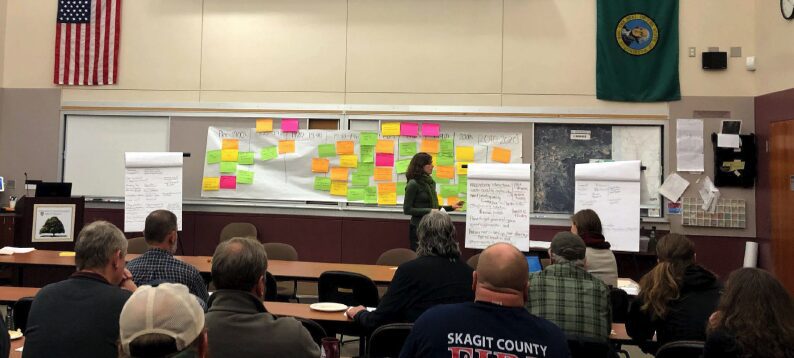
Figure 29. A soil health roadmapping listening event with local producers held at WSU Mount Vernon Northwestern Washington Research and Extension Center. (Photo: Benedict)
At the roadmapping event, the group discussed major issues of soil compaction and maintaining soil structure that result from the nature of the potato-driven system that necessitates there are no hard soil clods that cause blemishes or misshapen potato tubers. Therefore, growers routinely till the soil until all soil clods are broken up. The resulting loss of soil structure may lead to issues with saturated and flooded fields from fall to early spring due to poor drainage and may cause issues with reduced water-holding capacity (from reduced porosity) in the summer.
The growers also mentioned that profit margins are very tight and, while preferred, “resting” fields in cover crops or forages for multiple years is difficult between potato crops. Growers also mentioned that there is not enough land base for a five-year rotation, so potatoes are grown every three to four years, which is recognized to have significant detrimental effects on the soil. To assist with this, growers need a rotational crop with good economic viability. This could be achieved by developing mechanisms to value rotational crops (e.g., grasses, alfalfa, cover crops, forages) in terms of the soil health and environmental benefits they are providing.
Participants also outlined issues with soil pH. In potato systems, ideal pH is below 6.0 to prevent issues with scab (Streptomyces scabes). However, spinach seed crops (that are rotated with potato crops) are regularly limed to mitigate Fusarium wilt pressure, which is exacerbated at low pH. Previously, there was tighter integration of annual crops with dairy operations and therefore more manure applied to fields. The organic matter additions in the manure were beneficial as they helped to buffer soil pH changes and led to higher yields. Growers identified that with fewer dairies in the area, there is not enough dairy manure available and therefore less organic matter inputs than there were previously. However, some growers also associated raw manure additions with increased scab on potatoes.
2
Current Understanding of Soil Health
Growers discussed that when a soil is healthier, it makes the growing process easier the whole way through and that they find that the healthier soil is easier to work in preparation for planting, requires fewer irrigation events, and produces higher yields and higher quality products. They described knowing a good or healthy field as an innate feeling based on look and feel but were interested in improved metrics to confirm their observations. Regenerative agriculture was also mentioned and associated with needing fewer chemical inputs. Participants also associated soil health with high functioning of soil organisms.
Definition and Components of Soil Health
Participants associated soil health with soil organic matter, fertility, pH, biology, and tilth. One subgroup was particularly curious about soil biology and wanted more information outlining ways to help soil biological activity and “not hurt it.” They thought of this particularly in terms of tillage, asking how one tillage event vs. several events affects soil organisms and whether there is a threshold at which microbial communities are “harmed.” Participants discussed physical (e.g., workability), chemical (e.g., pH, soil organic matter), and biological (e.g., decomposition, competition with pathogens) aspects of soil health.
Important Functions of Soil Health
Growers identified the most important functions of soil health as:
- Increasing resilience against the uncertainty of water availability.
- Improving root growth to allow roots to access water deeper in the soil profile and perhaps improve capillary rise of water toward the soil surface.
- Buffering against pH changes, which would help manage soil fertility and pathogen pressures.
- Allowing for better soil workability and fewer tillage passes.
3
Goals and Priorities
Most Important Soil Health Issues
The primary issues for producers in this region are related to soil physical properties, including soil compaction, affecting root growth, drainage, and water-holding capacity, and poor soil structure, which causes poor water infiltration, hard surface crusting, increased tillage, and issues with seed germination and growth. Additionally, producers have issues with pathogen pressure, which is in part driven by challenges with managing soil pH, as described above.
Causes of Soil Health Issues
Issues with soil physical properties are caused by the intensive tillage and equipment traffic necessitated by the potato-driven rotation, and the fact that traffic often occurs at times when the soils are very wet due to spring and fall precipitation. Occurrence of tillage and harvests when soil moisture is higher than ideal for field traffic exacerbates issues with soil compaction and crusting and further drives issues with drainage and flooded fields. Several growers are working to reduce disturbance in the rotation by including grasses or other cover crops in the rotation to allow the soil to “rest” from potatoes, but limited land and tight profit margins make this challenging. Growers also recognize that soil organic matter and soil biology play a role in helping to reduce issues with compaction and water management and are working to find ways to increase organic matter inputs to the soil.
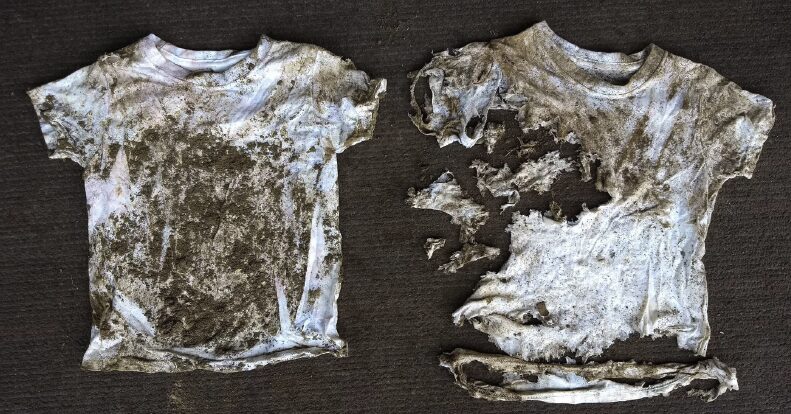
Figure 30. Results after two cotton t-shirts were buried in a regularly tilled field (left) and a field that had not received tillage for eight years (right). Higher soil microbial activity broke down the t-shirt on the right more quickly. (Photo: Griffin LaHue)
Soil Health Benefits
Participants stated that improved soil health would lead to reduced compaction, which would in turn would improve soil workability or tilth (requiring fewer tillage passes to prepare fields for planting), as well as soil moisture management with better water infiltration and drainage. Growers stated that they currently have challenges managing soil moisture, with flooded fields much of the year and moisture-stressed fields in the summer, and that improving soil health would make it easier to manage water throughout the year.
Key soil health research priorities for agriculture in Northwestern Washington include:
- Quantifying the incremental benefits gained by keeping a field out of potatoes each year (lengthening the rotation).
- Investigating which aspects of virgin soils (not previously cultivated, particularly with potatoes) lead to such high yields with the first potato crop, and how non-virgin soils can be managed to achieve similarly high yields. Deciphering the connection between the high productivity of virgin soils, soil biological communities, and soil fertility (micronutrients).
- Optimizing cover crop management including termination methods and timing. For example, whether it is better to terminate cover crops while vegetation is green or brown, whether chopping a green cover promotes more root exudation and benefits microbes, timing of nutrient availability if you let a grain crop “rot back into the ground,”, and the degree to which cover crops are nutrient scavenging and preventing nutrient loss while they are growing.
- Better understanding of the functions of soil biology and how soil biological communities are affected by soil management.
- Improving water management with soil health by determining whether improved soil health can increase rooting depth and capillary rise of water from the water table, thereby reducing the need for overhead irrigation.
4
Information Gaps
In addition to the research priorities listed above, information gaps that are critical to improving soil health for this system include:
- Quantifying the value of services provided by rotational crops and cover crops, such as fertility, increased water-holding capacity (fewer irrigation events), and carbon storage, in order to create a structure for generating economic gains when using longer rotations.
- Lack of standardization of methods for measuring soil health, availability of simple measurement tools, and understanding of the meaning behind these measurements (e.g., soil microbial communities).
- Elucidating mechanisms and organisms driving disease-suppressing vs. diseaseenhancing soils.
- Better understanding of the options for optimizing tillage in this system, including equipment options to reduce the number of passes needed and knowledge of how the timing of existing tillage operations is affecting the soil.
Milestones
Growers in this region expressed wanting to get to a point where they have rebuilt the soil organic matter that has been lost over decades of cultivation and to ensure that “no further harm” is being done to the soils, for example by stopping oxidation of organic matter by tillage. Rather than setting a quantifiable milestone, they want to know that their management is moving soils in the “right direction,” one where soil organic matter is accumulating over time, soil structure is more resilient, water dynamics (e.g., drainage, water-holding capacity) are improved.
5
Barriers to Adoption
Cover crops: The ability of cover crops to either introduce (through untested or low-quality seed) or harbor disease (through living biomass or stubble) was cited as a significant barrier to adoption/ use, most obviously in the case of brassica cover crops that are grown in proximity to vegetable seed crops and fresh-market brassica crops. Other barriers include poor germination with low-quality cover crop seed, seed predation pressure from migratory birds, seed cost, and insufficient growing degree days to get good establishment after late harvested crops (which increases susceptibility to bird pressure).
Crop rotations: Land trading is very common in the area due to complex rotations but can stifle investment in the land. Economic considerations force producers to shorten the rotation (there is not enough land or other income to do a 5-year potato rotation) and practices that can shorten rotations (e.g., liming) are always appealing since they allow producers to get more out of their own ground (vs. leasing it out).
Reduced tillage and leaving residue: Participants stated that some crops, such as corn, can handle residue and that incompletely incorporating residues can help reduce soil crusting but also create problems with plant disease survival. Furthermore, hard clods can cause misshapen potatoes, so marketable high-quality potatoes typically require many tillage passes.
Organic amendments: It can be challenging to incorporate amendments (e.g., compost) in the sheer quantity needed during the busiest times of year (before planting and after harvest). Previous experiences with low quality organic amendments have created perception barriers to their use, including mill waste that had grass seed and “sewage sludge” that left a field unable to be planted. The expense of many organic amendments limits their use (e.g., compost needs to be on a field going into a high-value crop, biochar has been produced locally but at too high a price), and dairy manure is in limited supply and can’t be economically transported more than a few miles from the farm. Lastly, organic amendments bring concerns about plant diseases (e.g., scab), food safety risks, and public perception.
Overcoming the Barriers
While no one solution can completely overcome these barriers, the need that workshop participants stressed repeatedly was for financial incentives for land stewardship. These could take several different forms, such as: 1) Valuation of the economic benefits of management practices to build soil health, 2) Inclusion of stewardship requirements in leases and other contracts (some contracts have stipulations pertaining to nutrient levels), or 3) Direct payments for certain management practices to help producers overcome constraints of tight profit margins. Other solutions specific to particular barriers include using cover crops that are less susceptible to bird damage and well-adapted to late planting and access to high-quality organic amendments at reduced cost.
Soil Health Policies
As mentioned above, financial incentives for management practices that build soil health would be a key policy solution. For example, carbon credits could be offered for keeping fields in perennial grass or sod, allowing producers to lengthen their rotations (or for other practices that build soil organic carbon). Access to irrigation water was also raised as an area where policy solutions are needed, possibly because uncertainty can stifle investment. It was emphasized that “soil health is a public resource” and as such, needs to be incentivized appropriately.
6
Resources/Tools/Opportunities
Resources and tools that provide technical guidance for specific management practices and especially, for standardized measurement of a key suite of soil health indicators, would be important to advancing soil health in northwestern Washington. Participants stressed the importance of standardizing the metrics for monitoring soil health (and other soil properties, such as soil moisture), so that producers can compare with their neighbors and reliably compare their baseline conditions to future measurements.
Cropping System Specific Issues
Northwestern Washington, and Skagit and Snohomish Counties in particular, have diversified annual crop rotations in peri-urban areas, which carry several important challenges. First, complex crop rotations and land trading are an integral part of the system, creating complications for adopting certain management practices and, in some cases, disincentivizing investment in land stewardship. Second, irrigation water access for many growers is subject to minimum in-stream flows, which creates uncertainty for growers and may limit investment (previously described). Lastly, the periurban nature of the agricultural system makes it subject to high land values and development pressure, mostly eliminates flooding from the river (and its associated costs and fertility benefits), and increases public scrutiny of agriculture.
Core Investments Areas
While this question was not specifically raised with stakeholders, several needs that directly translate to key investments were discussed. First, there is a need for biophysical and socioeconomic research to 1) quantify the ecosystem services and societal benefits provided by improved soil health, 2) inform policies that monetize the value of soil health and incentivize practices to build soil health, and 3) develop best management practices for specific soil health interventions and guide the implementation of these practices. Second, the importance of standardizing soil health indicators and educating stakeholders on how to use and interpret these indicators was stressed repeatedly, which will require some additional research and significant outreach and education efforts. Lastly, long-term monitoring of soil health in producers’ fields was identified as a key need, so that producers know whether their soil health is improving or declining. The aforementioned efforts will require interdisciplinary funding sources, and though the facilities and expertise to conduct this research exists within WSU, some additional investment in human resource capacity may be required.